

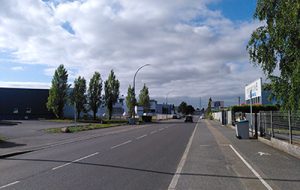
Highway serving an employment zone in northeast Nantes. ©Maxime Guinepain, June 2022.
Driving, Working, Looking After Kids, Sleeping?
A social geography of spatio-temporal patterns of working days and daily mobilities
Maxime Gignepain will defend his PhD thesis in geography and planning, entitled “Driving, Working, Looking After Kids, Sleeping? A social geography of spatio-temporal patterns of working days and daily mobilities”, carried out within the ESO and Géographie-cités laboratories and supervised by Jean Rivière (ESO research unit) and Julie Vallée (LISST research unit) on
Thursday 5th December 2024
2:00 PM
Campus des Grands Moulins
Espace Olympe de Gouges
8, place Paul Ricœur
75013 Paris
The “Espace Olympe de Gouges” is located on the first floor of the Olympe de Gouges building (former room 105).
Jury members
– Laurent CAILLY, rapporteur (Université de Tours)
– Anne LAMBERT, examinator (INED)
– Renaud LE GOIX, examinator (Université Paris-Cité)
– Antonine RIBARDIÈRE, examinator (Université Paris 1 Panthéon-Sorbonne)
– Jean RIVIÈRE, supervisor (Université de Nantes)
– Thomas THÉVENIN, rapporteur (Université de Bourgogne)
– Julie VALLÉE, supervisor (CNRS)
Abstract
In the era of ecological transition and energy costs on the rise, challenges posed by the magnitude of workers’ daily commute since the invention of mass transit and cars seem of more importance than ever. By underlining how unequally these problems affected them, the ‘yellow vest’ social movement in France also brought the political dimension of this question back to light. Yet, injunction to mobility, self-commitment to the professional sphere and the ‘typical’ organisation of everyday activities remain as prevalent as the single-house and home-ownership residential model, the importance of which is more often highlighted in research work.
This dissertation aims at appreciating the importance of such a normative social frame by using the notion of mostly class and gender ‘social rapports’ (a French expression that underlines the potentially conflictual aspect of social relationships). It allies both a Bourdieusian approach to workers’ dispositions and social capitals and a space-time analysis of work days inspired by time geography. To this end, it is based on an unprecedented analysis of 72 French mobility surveys conducted between 2009 and 2019 (included in the ‘Unified base’ constituted by the Cerema), with the addition of the 2019 ‘Enquête Mobilité des Personnes’. A complement is offered by some elements of qualitative research among concerned people. Through the intersection of fields of analysis too often separated in research (travelled distances, work schedules, activity programmes and transportation modes), this dissertation shows how much social hierarchies still shape the daily organisation of the working population, thus posing the risk both to obstruct necessary changes of practices and to make even more vulnerable the people who already struggle with constraints and social vulnerability.


