

 Dariusz Wojcik, co-author of the Atlas of Finance, will lead a seminar presenting the book as part of Renaud Le Goix and Petros Petsimeris‘ Urban Studies course in the M2 Geoprism.
Dariusz Wojcik, an award-winning and widely published economic geographer, is currently Professor of Financial Geography at the National University of Singapore and Honorary Research Fellow at Oxford University. His recently published Atlas of Finance is a comprehensive visualization of the world of finance across all continents, using a unique combination of data science, digital humanities, economics, geography and art.
Monday, December 2
10am to 12pm
Institute of Geography
191 rue Saint Jacques Paris 5e
room 401a (RER Luxembourg)
Reservations and registration (places are limited): https://framaforms.org/talk-invitation-dariusz-wojcik-1732108310
Dariusz Wojcik is a widely-published, award-winning economic geographer, specializing in financial geography. He is currently a Professor of Financial Geography at the National University of Singapore and an Honorary Research Fellow at the University of Oxford. His newly published Atlas of Finance is a comprehensive visualization of the world of finance on all continents, through a unique combination of data science, digital humanities, economics, geography, and art.
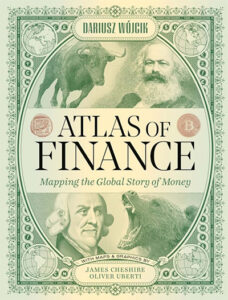 Presentation of the book
From the emergence of money in the ancient world to today’s interconnected landscape of high-frequency trading and cryptocurrency, the story of finance has always taken place on an international stage. Finance is one of the most globalized and networked of human activities, and one of the most important social technologies ever invented.
This volume, the first visually based book dedicated to finance, uses graphics and maps to bring the complex and abstract world of finance down to earth, showing how geography is fundamental for understanding finance, and vice versa. It illuminates the people—including Adam Smith, Karl Marx, and John Maynard Keynes—who have shaped our thinking about global finance; brings to life the ways that place-specific histories, laws, regulations, and institutions influence finance; shows how finance relates to innovation, globalization, and environmental change; and details how finance plays a key part in drawing the landscape of uneven development, inequality, and instability.


