

Preparation of an ALL-KDE project, C. Grasland, 2022.
Dates: 2026-2030
Intralaboratory Program Leader: Claude GRASLAND
Team: TERMS
Partner Organisations: Sorbonne Université, Université Paris -Panthéon – Assas, Université Paris Cité
Extralaboratory Program leaders: Fanny PASCUAL, Thomas EHRHARD, Jean-François LASLIER
Funding: ANR
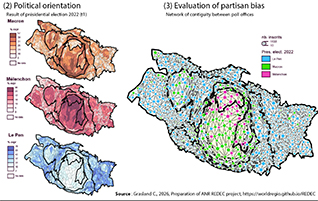
Description: The Redec project (REDistricting and legislative Elections in France: a Computational approach) aims to build an expertise about the electoral map in France by assembling a consortium of researchers with expertise in political science, economics, geography and computer science.
In particular, the project REDEC aims to quantify more precisely the impact of the choices made to define electoral map on the final outcome of the election. We aim to identify and clarify the parameters which have a significant political influence, and which should therefore be designed with special care, but also to show which ones are less influential. Transparency is a goal of REDEC, and one of its objectives is to transfer the knowledge on electoral maps and their influence to citizens.
The tools and algorithms developed by REDEC are designed to be reusable for evaluating any future redistricting reform. First, the electoral results obtained on the current electoral map remain a valid baseline reference, and will serve precisely to evaluate new maps. Second, we provide new tools to analyze past redistricting reforms, complementing traditional historical data. Third, our algorithms rely on fundamental building blocks (cantons) and enforce standard constraints such as geographic contiguity and population balance across constituencies within a given department. These are widely used rules, which make it possible to extend our map-generation algorithms to other systems—for instance, in France if future legislation introduces a proportional component leading to constituencies of varying sizes, or in other countries with similar constraints. Finally, while future legal changes may require recomputing legal maps, the analytical and visualization framework developed in the project will remain fully relevant, thereby ensuring the long-term impact and usability of our results.


