

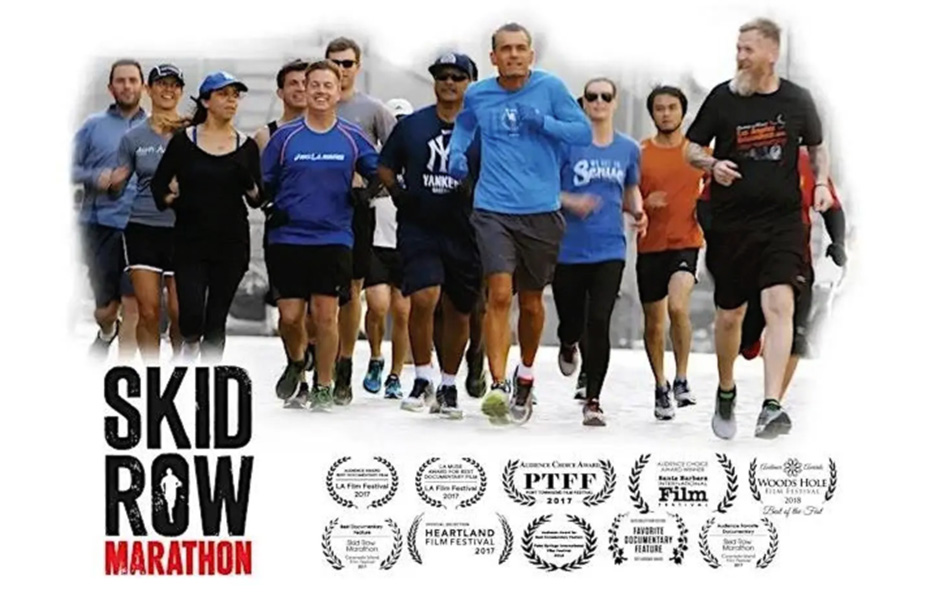
Q&A after the screening with Judge Craig Mitchell and the filmmakers
Friday, April 10, 2026
3:30 PM
MK2 Bibliothèque
128–162 avenue de France, 75013 Paris
On the occasion of the Skid Row Running Club’s visit to Paris for the Paris Marathon, a special free screening of the documentary Skid Row Marathon will be held at MK2 Bibliothèque in the presence (no comma) of American Judge Craig Mitchell and the filmmakers Mark and Gabriele Hayes.
Founded in Los Angeles in 2012 by Criminal Court Judge Craig Mitchell, the Skid Row Running Club brings together men and women living on the streets, people released from prison and drug addicts. Over the years, the discipline of running with the Judge has helped them reconnect with their own dignity. What began with three members has grown to 150 active members today, and the club has already participated in 25 marathons, including 10 international races.
The documentary Skid Row Marathon tells this extraordinary human story and follows several members of the club as they prepare for a marathon, facing daily struggles, resilience, and the hope of a second chance.
This year, 40 members of the club will travel from Los Angeles to take part in the Paris Marathon. On this occasion, the Paris public is invited to discover the film during a screening followed by a discussion with Judge Craig Mitchell, some runners and the filmmakers. After conducting research with many members of this group (interviews), Renaud Le Goix set up this event as part of this research on running in urban environment, with UMR Géographie-cités and Université Paris Cité.
At 6:00 am every Monday and Thursday morning, the Skid Row Running Club meets in front of the Midnight Mission, at the corner of 6th St. and San Pedro St. in Los Angeles. This program, created in 2012 by Judge Mitchell (Los Angeles Superior Court), aims at improving “the lives of those who are at risk of homelessness and addiction,” helping one person at a time to overcome alcohol and drug addictions. This program, which also includes a fundraiser to provide participants with the opportunity to run international marathons, is designed to keep participants focused on health and well-being, empowerment, solidarity, and care.
We went running with this group (and others), several times. We chose to introduce this research with this evocation because—although many see Los Angeles (LA) as a city where few walk—many people run, often in neighborhoods that are perceived as inappropriate or dangerous for running and training.Theorizing urban running as a spatially incorporated practice in cityscapes, this study addresses the need to link where and when runners practice, and how their place selection is linked to the city’s socioeconomic fabric.
Runners run at different spots and through various spaces: “different forms of running have different geographies” (Cook and Larsen, 2022). In LA, this covers from the beaches to the central business district, from the richest neighborhoods of Beverly Hills to the sidewalks of homelessness in Skid Row, from the flats to the mountain trails, and from the beaches to the scenic trails of Griffith Park. Our approach in this study stems from a basic assessment of what running means geographically to runners.
Renaud Le Goix. La La Run! A tale of two stories for a quantitative social geography approach to running and segregation in Los Angeles (to be published).


