

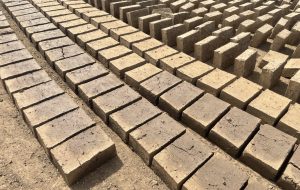
Bricks drying before firing at a brickworks in Omdurman (Sudan) © Pérez-Houis, 2022.
City in the mould
Setting in order and resistances of red brick supply chains in urban production of Greater Cairo (Egypt) and Greater Khartoum (Sudan)
Corten Pérez-Houis (Université Paris 1 Panthéon-Sorbonne / Géographie Cités laboratory) will present his doctoral thesis in geography, supervised by Éric Denis and Alice Franck, entitled “City in the mould: setting in order and resistances of red brick supply chains in urban production of Greater Cairo (Egypt) and Greater Khartoum (Sudan)”
Friday, December 6th
14h
Colloquium Center
Campus Condorcet
Salle 50
Place du Front Populaire
Aubervilliers
Jury
– Barbara Casciarri, University Professor, Université Paris 8 Saint-Denis – Examiner
– Armelle Choplin, Associate Professor, University of Geneva – Rapporteur
– Éric Denis, Research Director, UMR8504 Géographie-Cités – Director
– Alice Franck, Associate Professor, Université Paris 1 Panthéon-Sorbonne – Co-supervisor
– Roman Stadnicki, Senior Lecturer, University of Tours – Examiner
– Leïla Vignal, Professor, École normale supérieure de Paris – Rapporteur
– Serge Weber, University Professor, Université Gustave Eiffel – Examiner
Abstract
Since the 1980s, Khartoum and Cairo have experienced rapid urban and demographic growth. However, the production sites for one of the most massively used materials, red brick, are being challenged in both capitals (factory closures and abandonment, relocation). This urban geography study examines this apparent paradox by analysing the role of the red brick industry in the urban production of the two capitals. It assumes that this building material is a relevant observation site for contemporary urban transformations (sprawl, verticalization, hardening, commodification of space).
This material and comparative approach to the city is based on over a hundred interviews with a wide range of players (workers, brickworks owners, residents, architects, site managers, etc.), as well as observations, a press review and analysis of satellite images. The aim is to show that the socio-technical regime of the red brick (the material itself, producers, infrastructures, transformed resources, norms) is progressively marginalized. Red brick has been sidelined in the urban production of Cairo and Khartoum, as a result of public policies of modernisation and standardisation of the city. While tracing the construction of this undesirability by local and international institutional players, the thesis sets out to explain how red brick is maintained in these urban spaces, responding to a strong and persistent local demand for materials, including from the most critical players.


