

The redistributed crisis: visibility, attribution, and the governance of loss in office real estate in the Paris region
Kevin POISSON successfully defended his PhD dissertation in Geography and Spatial Planning on September 28 at Université Paris Cité. Entitled “The redistributed crisis: visibility, attribution, and the governance of loss in office real estate in the Paris region,” the dissertation was conducted under the supervision of Renaud LE GOIX.
The doctoral research was carried out within the Géographie-cités laboratory, in partnership with BNP Paribas Real Estate through a CIFRE industrial research fellowship. Kevin POISSON examines the downturn of the office real estate market in the Île-de-France region and its corollary question: how do losses become visible, to whom can they be attributed, and how do stakeholders attempt to manage them?
Abstract
Since 2022, the office market of the Paris region has turned down: vacancy is rising, values are falling, and loans are being renegotiated. Yet this general downturn does not produce the same losses everywhere: some buildings stay let and are refinanced, while others stay empty, can no longer be sold, or find a way out only through conversion, insolvency proceedings, or a public buyout. This dissertation in geography explains these differences. While the geography of real-estate financialization has mostly studied the upswing of markets, this dissertation studies the downswing. To do so, it moves from the crisis, which describes the state of the market, to the loss, which always sits somewhere (a building, a debt, a company, a fund) and falls on someone.
The inquiry draws on workplace observation from 2021 to 2024, under an industrial doctoral contract (CIFRE), followed by 34 semi-structured interviews with public and private actors. It combines street surveys of buildings, listings, market series, land and property data, company registers, and planning and court documents.
Four results emerge. Loss becomes visible only in fragments: the empty offices observed from the street and the offices listed on platforms only partly overlap, and a few private producers choose which figures circulate without publishing all their calculation rules. Loss is then hard to attribute: buildings are held through chains of companies, funds, and management companies, which the inquiry traces up to the last documented link; in several cases, the ultimate holder remains unknown. Loss also has several geographies: values fall by 9% in central Paris and by 31% in the northern inner ring, and the ways out close more often in the rings closest to Paris and in La Défense, where loss becomes captive. Finally, loss is handled through three operations: buying time (temporisation), having it recognised in a right or a procedure (opposability), and changing the use of the building (transformability).
These operations are not within everyone’s reach. The dissertation calls constrained governance of loss this partial coordination among actors who depend on one another without having the same means. It does not establish who pays in the end; it establishes who can wait, exit, or transform. The geography of financialization is also a geography of losses.
Jury
– Natacha AVELINE, Senior Research Fellow, CNRS, UMR Géographie-cités (Committee Chair)
– Guilhem BOULAY, Professor, Avignon Université, UMR ESPACE (Reviewer)
– Olivier CREVOISIER, Professor, University of Neuchâtel (Reviewer)
– Francesca ARTIOLI, Professor, Université Paris-Est Créteil, Lab’URBA (Examiner)
– Ivana SOCOLOFF, Senior Research Associate, Université Gustave Eiffel (Examiner)
– Richard MALLE, Associate Professor, Conservatoire national des arts et métiers (Examiner)
– Renaud LE GOIX, Professor, Université Paris Cité (Dissertation Advisor)
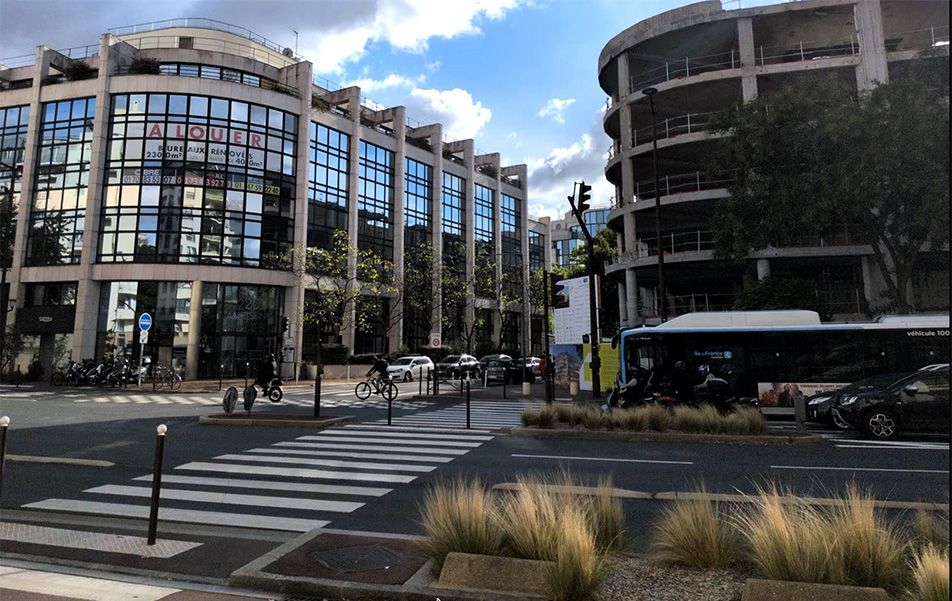
Rueil-Malmaison, September 2025. Left: office spaces for rent; right: an office building under renovation. Photo credit: Kévin Poisson, September 22, 2025.
 In September 2026, Kevin POISSON joined LATTS (Laboratoire Techniques, Territoires et Sociétés) at the École nationale des ponts et chaussées as a postdoctoral researcher. He is currently working on the ANR/FAPEPS FinPlanet project, a French-Brazilian collaborative research initiative coordinated by Félix Adisson, Ludovic Halbert, and Lucia Shimbo. His current research focuses on real asset investments and their social and environmental impacts.


