The heterogeneity of cycling within and between functional urban ereas: A modeling approach
Université Paris 1 Panthéon-Sorbonne doctoral candidate Léo Taillandier will defend his PhD dissertation, entitled “The Heterogeneity of Bicycle Use Within and Between Functional Urban Areas: A Modelling Approach”. The dissertation was conducted at Université Paris 1 Panthéon-Sorbonne and within the Géographie-cités research unit, under the supervision of Anne Bretagnolle.
Monday, June 1
2:15 p.m.
Research Building South
Room 0.033
Campus Condorcet
5 cours des Humanités
93300 AubervilliersFrance
Jury
Philippe Apparicio, Full Professor of Geography at Université de Sherbrooke (reviewer)
Anne Bretagnolle, Professor of Geography at Université Paris 1 Panthéon-Sorbonne (thesis supervisor)
Laurent Chapelon, Professor of Spatial Planning and Urban Studies at Université Paul-Valéry Montpellier 3 (reviewer)
Thierry Feuillet, Professor of Geography at Université de Caen Normandie (examiner)
Patrick Rérat, Professor of Mobility Geography at Université de Lausanne (examiner)
Abstract
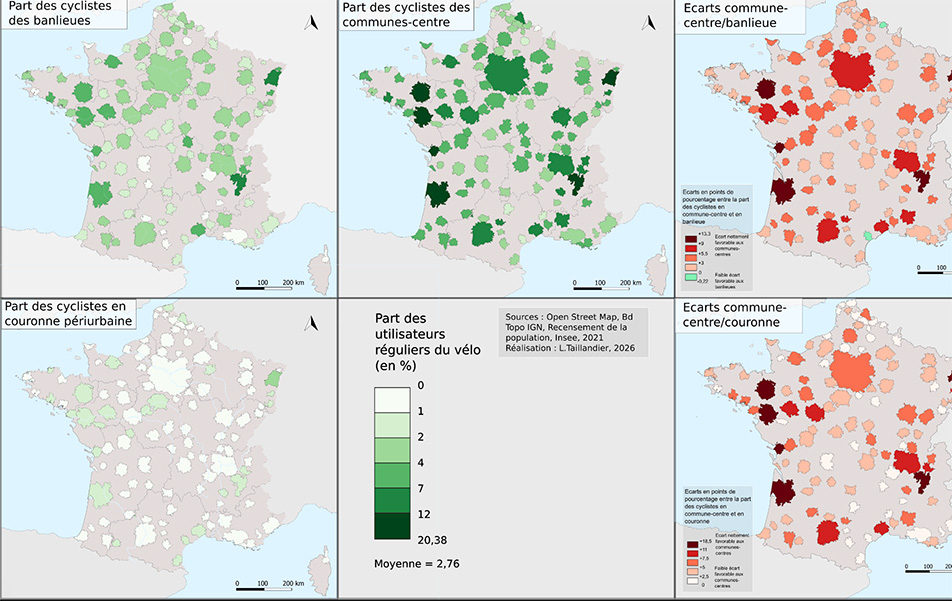
In France, cycling has grown significantly in the centres of major urban areas, but remains limited in the suburbs and very low in the outer suburbs. This thesis aims to explain these spatial disparities by analysing the mechanisms that shape cycling behaviour at different scales.
It is based on an integrated multi-scale approach, combining comparisons between French and foreign urban areas with a detailed analysis of intra-urban variations. This framework allows us to move beyond single-scale interpretations of inequalities in cycling behaviour. The analysis draws on the construction of original databases derived from travel surveys, the census and geospatial data (notably OpenStreetMap). These data feed into multilevel models that identify the relationship between individual factors (cycling potential) and contextual factors (cyclability of spaces), as well as the spatial heterogeneity of their effects.
The results show that the disparities between city centres and suburbs cannot be explained solely by travel constraints specific to suburbs, but rather by a combination of an higher car ownership rate in suburbs and a concentration of cycling policies in city centres, which are often tailored to high-density contexts. They also highlight spatial variability in the determinants of cycling, emphasising the contextual nature of the mechanisms at work. This thesis thus offers a systemic, multi-scale analysis of inequalities in cycling, highlighting the structuring role of public policies and, more broadly, of spatial contexts.