

 TICCIH 2022 : Montreal congress proceedings
The TICCIH 2022 proceedings have been published in the form of a book (Patrimonium Editions, Canada) edited by Juliette Passilly and Lucie K. Morisset.
The congress which took place in August 2022 in Montreal (Canada) explored themes such as the Adaptive reuse of industrial sites, Industrial landscapes and sustainability, Mega-events and industrial heritage and Digital documentation and interpretation.
The book includes Varvara Toura‘s article intitled: “Preservation of industrial heritage and new approaches in urban planning: Examples of two projects of urban renewal in France. The sustainable neighbourhoods Ile-de-Nantes and Docks-de-Seine” which summarizes the key findings of her Phd thesis regarding the transformation processes of former industrial cities in France.
Industrial heritage, while a regular focus of public policy, is in some respects suffering from a growing neglect. While heritage studies have seen a definite multi-disciplinary upsurge, this critical renewal tends to fragment industrial heritage (for example, issues relating to the presentation of memory are considered independently and research into intangible dimensions has yet to conquer this field). The penetration of increasingly scarce university research and non-university research into the civilian sector remains a marginal phenomenon, despite the general intentions of public policy, and even though this industrial heritage is claiming an increasingly important significance at ground level and in the collective imagination (albeit dysphoric) of the general public, particularly those groups suffering from the ravages of deindustrialization.
This book, which brings together the proceedings of the 2022 congress of The International Committee for the Conservation of the Industrial Heritage (TICCIH), held in Montreal (Canada), sets out to bridge some of these gaps by jointly discussing the effects and issues of industrial heritage, including from the usually more materialistic considerations of its composition, its design or its appearance, for example, taking advantage of the fact that the marked obsolescence that normally affects it remains a privileged springboard for exchanges on its role and use in contemporary society. The hope is that industrial heritage – and its bearers – will be an agent rather than a victim of change, in the spheres of economics, politics, society, law, and environmental management, to name just a few.
In these unique circumstances, it was more than appropriate that the conference title—and theme—was “Industrial Heritage Reloaded.” There could not have been a better moment to take a fresh look at industrial heritage and explore its complexities, strengths, and weaknesses. The resulting program challenged and broadened our traditional definitions and perspectives through a series of inspiring sessions, the fruits of which can be found in the collection of articles in these proceedings. The specific aims of the conference were therefore to break free from the confines of past perceptions and practices and to address new and overlooked themes, thereby escaping from the “generic narrative.” In particular, this entailed tackling both positive and negative issues, adopting a more inclusive approach, and expanding geographically to include those parts of the world that had previously escaped attention. So, whilst the established and recognized strands of industrial heritage were not ignored, they were to be reassessed, and a much broader agenda adopted.
From Preface
“Industrial Heritage Reloaded, Proceedings of the XVIIIth TICCIH Congress” published by Éditions Patrimonium, will be available in print-on-demand and can be purchased in two volumes here.
Juliette Passilly (Author), Lucie K. Morisset (Editor) Industrial Heritage Reloaded | Patrimoine industriel rechargé: Volume I.
Patrimonium, 2025, 494 p.
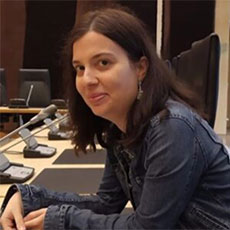 Varvara Toura
Architect-urban planner, researcher in urban geography. She holds a PhD in urban studies (geography, sociology, political science, heritage studies). Her thesis was conducted at EHESS/Géographie- Cités in Paris, France under the supervision of Professor Marie-Vic Ozouf-Marignier.


