

Scientific programs completed

Emmanuel de Martonne Corpus. Phase 2
Dates: 2021 - 2022
Phase 2 of the project, within the framework of Digital Humanities, promotes a second body of archives by geographer Emmanuel de Martonne (1873-1955) consisting of 6 field notebooks and 400 glass plates. As for phase 1, phase 2 analyzes, documents, archives and disseminates the archives according to a threefold problematic: that of the geographical heritage of textual and iconographic sources, that of Open Science and that of innovation in Human and Social Sciences.

Land conversion for urban uses in the global south
Dates: 2020 - 2021
This collective research focuses on the modalities of land use conversion in the Global South in relation to urbanization. The aim is, on the one hand, to identify and classify the conversion processes, the exits from agricultural use or the entry into the urban market on a macro scale and, on the other hand, to document the modalities of action and their effects on the basis of specific case studies.

DiffusEsperanto – Documenting the multilingual dissemination of a universalist project at the end of the 19th century: the digitization of the early writings of the Esperanto movement (1887-1892)
Dates: 2020 - 2021
As soon as Esperanto appeared in 1887, its promoters developed a multilingual propaganda to popularize this "international language". The project is to digitize the booklets published in several "natural languages" between 1887 and 1892 to promote Esperanto, documents scattered in European and Israeli libraries, and thus constitute a corpus for the analysis of the early diffusion of the Esperanto idea.

A sky still divided? Germany’s East and West, thirty years after reunification
Dates: 2020 - 2021
The project questions the observable differences between East and West German societies 30 years after reunification. It is based on ethnographic surveys conducted by Franco-German teams, returning to the thesis work of two anthro-pologists who had studied in the 1990s villages located in direct proximity to the former Iron Curtain.

Cartography of the exile in the Stalinist USSR
Dates: 2020 - 2021
The project is working on a cartographic representation of deportation trajectories and "special colonies" where, during the time of the USSR, entire population groups (about 6 million people) were relegated. A feasibility study is being carried out here for three control territories with a view to a generalisable approach for the whole of the USSR.
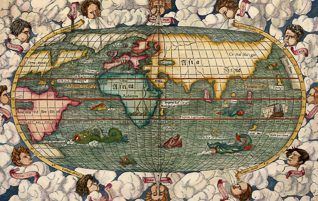
Circulation, geopolitics and the construction of knowledge about the world from the straits. The case of a world passage, the Strait of Magellan
Dates : 2020 - 2022
The project analyses the role of straits in the organization of political spaces on a global and regional scale in the modern period, and in particular examines the role of the Strait of Magellan in the processes of circulation of knowledge and narratives that linked Europe to the American continent. Other straits are studied in a comparative way (Gibraltar, Bosphorus, Malacca).

Governing Diverse Cities in Europe and Asia
Dates: 2019 - 2021
Cities in Europe and Asia have become the focal points of changing migration patterns. This context has challenged pre-existing models of management of urban diversity. In parallel, the rise of nationalist rhetoric feed the implementation of a number of exclusionary measures. This comparative projects contemplates the city as a key site to on emerging models of diversity governance.

MOREHOUSE (Modeling hOusing maRkets dynamics thanks to Emerging and HeterOgeneoUs data SourcEs)
Dates: 2019 - 2021
In this exploratory program in partnership with IFISC (Palma, ES) we uncover the structure of real estate agent networks that can be identified from ad data posted on platforms (SeLoger, LeBonCoin, Idealista, FotoCasa). The data are represented using bipartite networks linking agents and ads. The methods used are those of spatial networks science and community detection in ecological networks.

PaMIzMex When migrants in transit produce the city. Crossed views between Paris, Milan, Izmir and Mexico City
Dates: 2019 - 2021
To specify the power relationships at work in the deployment of migrant spatialities. To characterize the forms of presence/visibility of migrants in transit in the city in a relational approach to public spaces. Study the daily interactions with other urban actors, inhabitants, tourists, institutional actors. Overcoming dualisms by articulating the times of mobility and anchorage.

NETCONF “Scientific Networks and Congresses”. Understanding the effect of congresses on the dynamics of scientific networks
Dates: 2019 - 2021
The aim of this project is to characterise the effect that congresses can have on the dynamics of scientific networks and their internationalisation. To improve understanding of the social depth of scientific activity and the role of congresses in the circulation of knowledge and collaboration, NETCONF proposes to compare the case of two congresses in two disciplines: chemistry and political science.

NETSCITY “Analysing and visualising interurban scientific networks”
Dates: 2019 - 2021
This project aims to develop a platform for geospatial exploration of science data. The objective is to make available through an open access platform different options for processing and visualizing spatialized networks of contemporary science.

Inter-Friches – International and interdisciplinary workshops on urban wastelands
Dates: 2019 - 2021
Urban vacant lots, or wastelands, defined as transient spaces omnipresent in the city, became over the years a novel object of study in many disciplines (urban planning, geography, sociology, ecology). The workshops that we propose aim to define an interdisciplinary methodology to characterize wastelands’ in a systematic and transdisciplinary way.
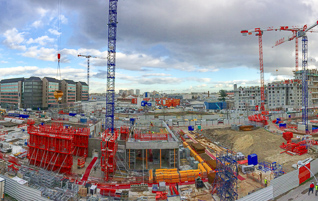
Ties and interactions between the Condorcet university campus and the local community
Dates: 2019 - ...
This research intends to question the local impacts of university campus' construction by analyzing the case of Campus Condorcet. We aim to better comprehend how local stakeholders perceive, promote or contest present and future urban transformations. This project is based on a collective research with students of EHESS from different disciplines.

Com2SiCa research program (Understanding and Simulation of Human Behaviors in areas affected by disasters: from analysis to policy making)
Dates: 2018 - 2021
The Com2SiCa research program (Understanding and Simulation of Human Behaviors in areas affected by disasters: from analysis to policy making) aims to improve understanding and the ability to anticipate individual and collective human be-havior in face of complex threats and disasters of all origins, breaking down traditional disciplinary approaches.

The world seen from Kazakhstan ; exploration of world representation from an in-between space
Dates: 2018 - 2020
A previous survey (EuroBroadMap, 2009-11) concluded that Central asia was a blind sport in mental representation of world regions. This result could be explained by a methodological bias: the drawn regions are centered on the respondents, yet no survey had been carried out in Central Asia. To answer this question, the survey was replicated in 2018-19 in Kazakhstan.

H2020 Odycceus (Opinion Dynamics and Cultural Conflict in European Space)
Dates: 2017 - 2020
Oddyceus seeks conceptual breakthroughs in Global Systems Science, including a fine-grained representation of cultural conflicts based on conceptual spaces and text analysis, game theory, and new models of alignment and polarization dynamics. It develops an open modular platform, PENELOPE, that integrates tools, from data scraped from social media and digital sources, to visualisation of the analyses and models.

Land-based commons for housing in the Global South
Dates: 2017 - 2020
To what extent can the “commons” approach contribute to the renewal of housing policies and programs? What is the feedback from the field of collective, cooperative, or commoning housing projects in Global South's cities?
Based on the notion of “commons”, this research scrutinizes forms of land tenure that are alternative to private ownership and guarantee land security in precarious neighborhoods.

Metropolises – Crisis and mutations in the Euro-Mediterranean space
Dates: 2017 - 2021
The program, led by the Ecole française of Rome (EFR) in collaboration with the Ecole française of Athens (EFA) and (until 2019) the Casa Velazquez (Madrid), questions the effect of the 2008 subprime crisis and the austerity policies on the Euro-Mediterranean in a trans-scalar perspective, based upon disciplines concerned with territorial issues (geography, planning, sociology, etc.). It is based on scientific meetings, doctoral training workshops, and publications.

Emmanuel de Martonne Corpus. Phase 1
Dates: 2017 - 2020
This project promotes the archives of the French geographer E. de Martonne (1873-1955) within the framework of Digital Humanities. The corpus of 7 field notebooks and 800 glass plates is analyzed, documented, archived and disseminated according to a threefold problematic: that of the geographical heritage of textual and iconographic sources, that of Open Science and that of innovation in Human and social Sciences.

RelatHealth- A relational approach to place effects on health in cities
Dates: 2018 - 2021
In RelatHealth project we propose to analyse place effects on health focusing on accessibility to various urban resources, such as health care facilities but also commercial, cultural, transportation and leisure facilities. We aim to reconsider the notion of accessibility combining not only spatial distribution of urban resources but also people’s place experiences and to explore inequalities in resources accessibility may translate into inequalities in health. Two cities are more specifically studied : Paris and Montreal.

HANC – Healthy Aging and Networks in Cities: The combined role of built environments and socio-spatial networks
Dates: 2016 - 2021
The HANC project aims to examine well-being and health status of older adults in relation to urban environments, mobility behaviours and social network.

EIGHTIES
Dates: 2016 - ...
Interdisciplinary and international team of researchers created by Thomas Louail in 2015 and founded by the RNSC (national network for complex systems) and the LabEx DynamiTe. The team aims to address quantitative geography issues and theories with massive observational and simulated data.
Programmes scientifiques terminés
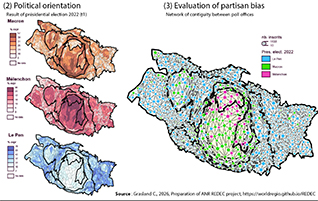
Redec
Dates: année de début - année de fin The Redec project (REDistricting and legislative Elections in France: a Computational approach) aims to build an expertise about the electoral map in France by assembling a consortium of researchers with expertise in political science, economics, geography and computer science.

Divsky
Dates: 2024 – 2027 The project aims to capture and analyze the life experiences, social practices, and worldviews of residents along the former inner-German border.

Thesis Defense: Thomas Rosenthal
Helping One’s World. A Political Geography of Aid as Delivered by French Development NGOs. Tuesday, October 13, at the Sorbonne (Paris, France).

Industrial Heritage: Places, Memories, Renewals
The call for papers is now open and will remain open until 1 March 2027.

Territorial Transitions in the Context of Contemporary Global Crises
The call for papers for the 7th forthcoming CIST conference is open until 11 December 2026.
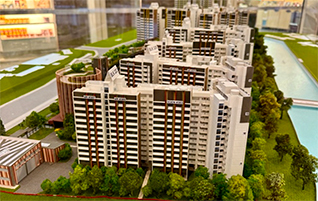
RENEWAL – Aging in the context of urban renewal — A French-Singaporean comparison
Dates: 2026 - 2028 This project examines how urban renewal policies in the Paris region and Singapore address the needs of older adults aging in place within modernist neighborhoods.

Nadine Roudil, Visiting Professor at the University of Chicago
Nadine Roudil is currently hosted by the UChicago-CNRS HumanitiesPlus International Research Laboratory at the University of Chicago.

Thesis defense: Antoine Gosnet
Producing social housing around the Grand Paris Express: Institutional change, local strategies, and socio-spatial recompositions. Thursday, 10 September at Campus Condorcet.

Land-Based Commons for Housing and Inclusive Cities
A paper by Claire Simonneau and Eric Denis published in the International Journal of the Commons.

Kai Shang, a visiting PhD student
Kai Shang (Tsinghua University, Beijing, China), is a visiting PhD student at Université Paris Cité and the UMR 8504 Géographie-cités laboratory for a six-month research stay.
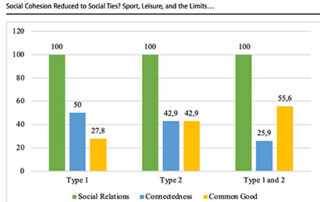
Social Cohesion Reduced to Social Ties?
Sport, Leisure, and the Limits of Migrant Inclusion in Spain, an article co-authored by Julien Puech.
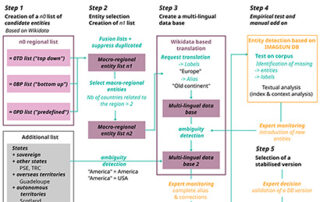
A multilingual dictionary for the recognition of macro-regions and countries mentioned in daily press news
A data paper by Claude Grasland and Etienne Toureille published in the Cybergeo online review.
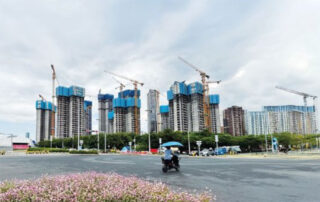
Towards a New Urban Regime? Reconfiguring Urban China through Internal Migration”
A presentation by Cinzia Losavio, at the Department of Geography and Resource Management of the Chinese University of Hong Kong on June 25.

The hidden number of Chinese Cities
How can we explain the deliberate omission of the vast majority of small and medium-sized cities in most studies on urban China?An article by Denise Pumain for the Cybergeo Conversation Blog.
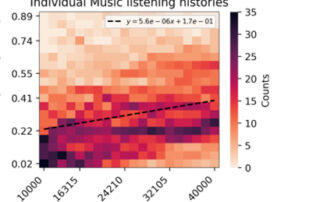
Dynamics of discovery and the Heaps-Zipf relationship
A paper by Célestin Zimmerlin, Thomas Louail, Manuel Moussallam and Marc Barthelemy.
Gábor Sonkoly on an official academic mission at the University of São Paulo
Gábor Sonkoly will deliver lectures on June 1, 3, 11, and 15.
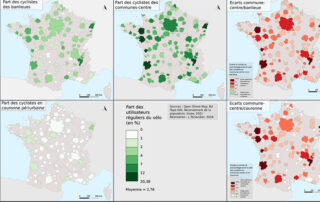
Thesis Defense: Léo Taillandier
The heterogeneity of cycling within and between functional urban ereas: A modeling approach. Monday, June 1 at Campus Condorcet.
The Legal Spatiality of Land, Water, and Infrastructure
This seminar will take place on June 8, 2026, at Campus Condorcet.
Sustainable Pathways for Waterborne Transport in Ukraine
Ivan Savchuk contributed to the recommendations submitted to the Government of Ukraine in preparation for post-war reconstruction.
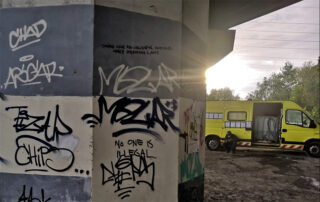
DISEE – Spatial Dimension of Engagement with Exiles
The DISEE project examines the spatial dimension of discouragement, the making of "long-term volunteers," and the circulation of knowledge between engagement territories.
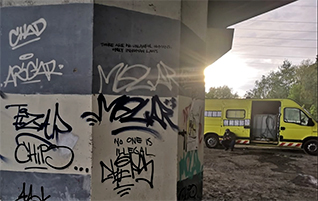
DISEE – Spatial Dimension of Engagement with Exiles
Dates : 2026-2027
The DISEE project studies how spatial configurations – peripheral relegation of makeshift camps, distance from urban centers, fragmentation of intervention sites – affect the trajectories of voluntary engagement with exiled people. The project focuses more specifically on two borderland field sites (Calais and Briançon).

Mobility and Daytime Population in Geographical Space
Chapter 3 of the volume The Mobile Individual: Everyday Life, Long-Term Temporalities, and Mobile Subjectivities", authored by Hadrien Commenges and Julie Vallée.
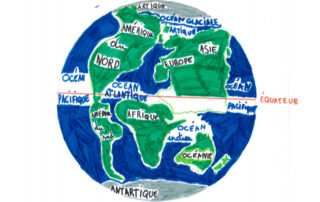
Children’s global imaginaries
The sociogenesis of political and moral views of world space in childhood: a paper by Anne-Cécile Ott published in Children's Geographies.
Affordable housing, finance and the state: Towards a global urban comparison
A comparative analysis of six metropolitan areas: Shanghai, Nairobi, Paris, Casablanca, Salford, and Rome, with the contribution of Antoine Gosnet.
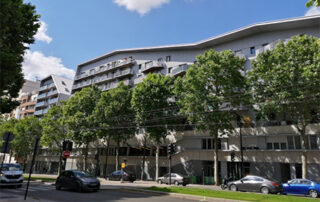
PALACE — Research project on housing access for civil servants
Dates : 2026-2030
This research project analyses the strategies of public employers in the Paris region that aim to improve housing access for their staff, in a context of recruitment difficulties and adaptation to climate change.

Special screening of the award-winning documentary Skid Row Marathon
With Judge Craig Mitchell and the filmmakers, Friday, April 10, 2026 at MK2 Bibliothèque.
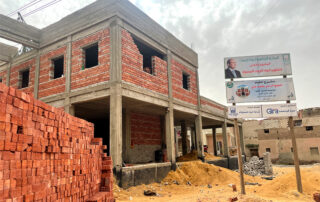
Declining red brick factories in Greater Cairo (Egypt)
Unveiling military-led urbanization through its productive peripheries: an article by Corten Pérez-Houis.

Defining the “medium-sized city”
Reflections on a territorial category at the crossroads of urban research and public policy, by Achille Warnant.
Impact of Geopolitical Factors on Ukrainian Seaports during the Ongoing Russian–Ukrainian War
A chapter of "Ports in the Polycrisis: Navigating Geopolitical, Ecological, and Institutional Challenges", by Ivan Savchuk.
European Heritage Label Selection Report 2025
It was prepared under the direction of Gábor Sonkoly, EHL Selection Panel Chair, Sigita Bugenien and Zdeněk Novák, General Rapporteurs.
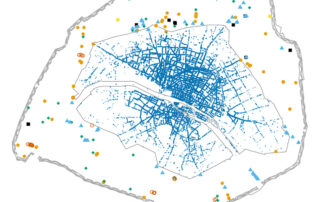
Evaluating and Understanding the Geocoding of City Directories of Paris (1787-1914)
How these collections of millions of nominative entries associated with addresses can be turned into a serial dataset. An article cosigned by Julie Gravier.

Obscene Theming as Strategic Commodification of Public Spaces
Analyzing the Material Outcomes of Staging Sexualized Feminine Bodies in Venice Beach, by Alexandre Pires.
Sketches and lessons of past and evicted ‘biogeochemical policies’ in twentieth century France
An article by E. Dufour that aims to reopen the future of both urban sanitation and agriculture.

Diego Coletto, Guest researcher
Diego Coletto is a Visiting Professor at the EHESS / Géographie-cités.

Karine Duplan, Guest researcher
Karine DUPLAN is a Visiting Professor at the École des hautes études en sciences sociales (EHESS), within the research unit UMR Géographie-cités.

Adaptive Redesign of Urban Industrial Landscapes
The Case of the Technical Chamber Square in Komotini, Greece: an article co-authored by Varvara Toura.

Worlding geographies: A question of languages
Reflections by geographers working in different contexts around the world, including Renaud Le Goix.

Silently ageing, quietly shrinking
Examining age-friendly policy in French and Canadian shrinking cities, an analyse by A. Paumelle, R. Barber, B. Fernandez and M. Hartt.

Understanding Mosquito Burdens through an Urban Political Ecology of Singapore’s Residential Landscapes
An article by Natacha Aveline-Dubach and Raksha Mahtani.

Rock Against Communism in France (1984-2024)
An article by Laurent Beauguitte published in the thematic issue "Music and the Right" of the journal Transpositions.

Shifting land value capture instruments for the Grand Paris Express metro
Metropolitan governance, local trade-offs and urban outcomes: an open-access article by Juliette Maulat and Natacha Aveline.

ALTERMAP
Dates: 2021-2024
The ALTERMAP project aims to foster pedagogical innovation in the study of geographical imaginaries and representations of spatial otherness. More specifically, it focuses on the role of mental maps in undergraduate geography teaching and in research training at the master’s level.

Thesis Defense – Clara JULLIEN
The urban parenthesis. Migration trajectories from rural delta and coastal areas of Vietnam to Ho Chi Minh City in a context of uncertainty, on December 15, at Campus Condorcet.

Thesis defense – Martial VIALLEIX
"Urban Planning Put to the Test of Territorial Metabolism", on 18 December 2025 at Campus Condorcet.

Historic Urban Landscapes in Comparison: Budapest and Rio de Janeiro
The Conceptual Evolution of the Urban Landscape in World Heritage Cities. An essay by Gábor Oláh, Gábor Sonkoly and Luciano Torres Tricárico.

Modern and contemporary Europe
A volume that invites readers to reconsider the central paradigms of European urban history. Edited by Dorothee Brantz and Gábor Sonkoly.

Plural Values of Culture in Europe
The main results of the European project UNCHARTED. A volume co-edited by Gábor Sonkoly.

Thesis Defense – Congcong Li
"Institutional Mechanisms of Financing Transport Infrastructure in China — Comparative Lessons from the “Rail Plus Property” Model in Shenzhen and Nanjing", on December 15, 2025, Université Paris 1 Panthéon-Sorbonne.

Squat All Over the World
This international conference will take place on 8–9 January 2026 at Campus Condorcet (Aubervilliers, France).

Thesis defense – Ceyda SUNGUR
Pendulum of Survival: Socio-spatial Practices of Women Cleaning Workers in Istanbul, 24 November 2025, at Campus Condorcet.

Queer Exile
Screening and discussion on 2 December at Sciences Po, with the participation of Florent Chossière.

Thesis defense – Camile DABESTANI
Remaking the Caribbean. Student representations and appropriations of macro-regional imaginaries in a postcolonial context (Guadeloupe, Martinique). 27 November at campus Condorcet.

The Aftermath of the Ankara station massacre: the Agency of Urban Design in the Right to Memory
Deniz Kimyon Tuna analyses the politics of confronting atrocity and try to situate this politics within the right to memory.

Sandrine Robert in Residence at the Maison Française d’Oxford
As part of her residency at the Maison Française d’Oxford, Sandrine Robert will give two lectures on 21 November and 4 December.

Confinement and Exclusion
Re-Analysing the Geographical Metaphor of the Closet through Trans Experiences of Public Space. An article by Milan Bonté.

More volatile, less equal: housing and welfare in 21st century France
An Analysis of Housing, Welfare, and Inequality, by Renaud Le Goix, William Kutz, and Ronan Ysebaert.

Thesis defense – Thibaud BAGES
French regions and economic sector policies: a new planning model? Strategies and tools for developing hydrogen activity by the Hauts-de-France, Occitanie and Pays de la Loire regions. On November 21, 2025 at Maison de la recherche (Paris).

Thesis defense – Jean MAKHLOUTA
Carving Out a Place in the City. Mobilities and Spatial Strategies of Sexual and Gender Minorities in Beirut. Monday, 17 November at Campus Condorcet.

Thesis defense – Alexandra Mallah
Geography of the invisibles : the territories of Women's Memory. November 14, Campus Condorcet.

Bungalows and oil tanks: The environmental damages of petroleum refining and the urban politics of heavy industry
Clarence Hatton-Proulx analyzes the social and environmental consequences of fossil energy metabolisms on Montréal’s sacrifice fossil zone.

Naftali Naymanovich and the first Esperanto textbook for Yiddish speakers (1888)
An article by Denis Eckert, published in the journal East European Jewish Affairs.

Thesis defense – Mathilde PEDRO
Planning and Managing Transport Hubs in a Context of Sectoral and Territorial Reforms: A comparison between France, England, and the Netherlands.November 4, 2025 at Campus Condorcet.

Explaining infrastructural bifurcation: A comparative history of urban incineration in Montréal and Paris
How deindustrialization and gentrification put pressure on waste incinerators: an article by Clarence Hatton-Proulx.

Florent Chossière, visiting researcher at the University of Sussex
Florent Chossière will take part in several key events organized by the Sussex Centre for Migration Research (SCMR).

Commoning the gardens by the Bloc
Informal gardening practices in the collective housing districts of a post-socialist city, an article cosigned by Carmen Rafanell.

Industrial Heritage Reloaded
The TICCIH 2022 proceedings have been published in book form, with a contribution by Varvara Toura.

The quiet financialisation of urban infrastructure
The media in the normalisation of airport-led development in the Paris city-region, a paper by J.-B. Frétigny, M. Magnan, J.Maulat, M. Pedro.

The Fable of the “Energy Recycling” of Household Waste
In this article published in the Journal of Energy History, Etienne Dufour questions the virtue of using urban waste for energy production.

Queer Migrants in Transnational Social Spaces: Sexualised Geographies of Power
A call for papers for a proposal of special issue to be submitted to the journal Gender, Place & Culture: A Journal of Feminist Geography.

Passing of Éric Denis
We, at the Géographie-cités research department, are deeply saddened of the recent passing of our colleague and friend Éric Denis on August 21.

The Limits of a Success Story: Rethinking the Shenzhen Metro “Rail Plus Property” Model for Planning Sustainable Urban Transit in China
An analysis Congcong Li and Natacha Aveline-Dubach.

From gardening to landscaping, from LA QUINTINIE to tomorrow
Call fo papers - International symposium (Wednesday 11th and Thursday 12th, March 2026, France). Response deadline: Thursday 18 September 2025.
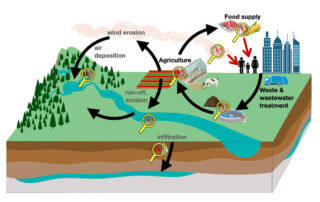
Why a strong global plastics treaty is essential for agricultural systems, food safety, food security and human health
A call from 12 researchers for serious consideration of the problem of plastic pollution of agricultural soils in the context of the forthcoming negotiation sessions for a Global Plastic Pollution Treaty to be held in Geneva in August.

Confinement and Exclusion
How Milan Bonté re-Analyses the Geographical Metaphor of the Closet throughTrans Experiences of Public Space.

Thesis defense – Sonia DINH
Designing shared facilities in private collective housing : perspectives from the practices and strategies of urban and real estate development professionals. July 10, Campus Condorcet (France).

Vilmouv
Dates : 2022 - 2026
This project explores the connection between mobility and urban transformations in the Mediterranean, within a context of major political and socio-economic changes. At the intersection of urban studies and mobility studies, it draws on a multidisciplinary and international team of specialists in urban issues, mobility, and migration.

Thesis defense – Jordi CALABUIG SERRA
The co-production of a city. Sociability and spatiality of LGBT+ residents and tourists in Barcelona. July 2 in Paris.

Marion Maisonobe awarded the CNRS 2025 Bronze Medal
Portrait of Marion Maisonobe, distinguished for her research in the fields of science geography and spatial scientometrics.

Proposal for the regeneration of the coastal front in the area of ‘Kalamia Corinth’
This proposal is an attempt to shape a new urban identity enhancing ecosystem resilience and sustainability.

Decentering Migration studies
The 22nd IMISCOE Annual Conference will take place between 1 - 4 July 2025, at Campus Condorcet (Aubervilliers, France).

Sunbelt 2025
The main international conference on Social Network Analysis will take place in Paris June 23-29.

A mega-rescaling-project ?
State powers and intra-state conflicts in the development of the Grand Paris Express station districts, analized by Antoine Gosnet.

Modeling the transformation of France’s postal exchange space (1632e1833) through multipolar anamorphoses
An article published by C. Mimeur, N. Verdier, A. Bretagnolle in the Journal of Historical Geography.

Postdoctoral Position – ANR PREcare Project (M/F)
Application Deadline : 13 June 2025 23:59:00 Paris time

Modeling the past to anticipate the future
Call for contributions for An International Symposium (on the 4th and 5th of December 2025, Paris). Deadline on June 30, 2025.

HDR Defence: Hélène ROTH
From One Transition to Another. Urban Shrinkage and Post-fossil Futures in Eastern Germany. Defence on Tuesday, June 3, at Campus Condorcet.

Squat all over the world
Call for papers. July 7, 2025 : deadline for submission of proposals

The City-Region Explorer Platform
Andrea Cattaneo (FAO) will present l'application City-Region Explorer, on may 28, 2025 at Campus Condorcet.

Common Interest Group for Transport in Ukraine
Ivan Savchuk will present his research on Ukrainian Danube ports at the conference on the reconstruction of transport in Ukraine on May 20.

Spatial fix through hospitals
Deniz Kimyon questions hospital geographies in Turkey with the introduction of City Hospitals.

Ukraine’s grain economy in the context of russia’s Full-scale invasion
To whether and to what extent the war caused changes in territorial production differences and sales abroad?

Balancing economic growth, environmental sustainability, and professional ambitions
The dilemma of municipal officials in China, a study by M. Li & N. Aveline-Dubach.

Alternatives to demolition
The strategies implemented by French social housing organizations to cope with housing vacancy.

Paysages d’Après | After-scapes | Paisagens do depois
An International symposium organized as part of the Landscape program, May 26-27, 2025 at the University of Lisbon.

Postdoctoral researcher (M/F)
Recruitment for the ANR VinoRosa program: Application deadline: Monday April 7, 2025.

Territory of a struggle for the right to a home in Paris, geography of a mobilisation and its suppression
A year-long ethnographic survey conducted by O. SEBILLOTTE and A. PIVA within the Réquisitions collective.

The Everyday Commoning Practices in Urbanising Localities
Negotiating Rights to Inhabit Common Lands for Housing in Two Cities of South India.

European Colloquium on Theoretical and Quantitative Geography
The call for abstracts for the 24th ECTQG (Tallinn, Estonia - 10-14/9/2025) is open until April 15, 2025.

Open Science thematic school for human and social sciences (SHS)
A training organized from June 22 to 27, in Saint-Pierre d'Oléron (France).

ElementR: The Geographically weighted regression (GWR)
A session led by Thierry Feuillet on March 20, 2025.

GIS 2025 workshop
2d cycle of the 2024/2025 GIS Workshop.

Mapping the Implementation Practices of the 15-Minute City
A holistic study of the 15-Minute City concept, its real-world application, and the primary principles embraced by policymakers.

Age-Friendly Futures Summit
Advancing, leading and creating city regions and communities for an age-friendly world (25-27 March 2025, Manchester)

The ENVERMET project
The socio-demographic changes that have taken place in Paris and Madrid since 2000 and the resulting challenges for public action.
![3] The factory CPCU in Saint- Ouen, ©Varvara Toura, 2023. The factory CPCU of the Parisian company of urban heating is located in the site of Docks-de-Seine near new residential buildings and shows the continuous presence of industrial activities in the area.](https://geographie-cites.cnrs.fr/wp-content/uploads/2025/02/preservation-industrial-heritage-toura-320x202.jpg)
The Preservation of Industrial Heritage as a Form of Urban Resilience
The Case Studies of Ile-de-Nantes and Docks-de-Seine, by Varvara Toura.

Shopkeepers and urban change
An analytical framework for studying commercial change from the shopkeepers’ perspective, from A. Fleuret & N. Rollinde.

Fire Storms in Los Angeles
Davis’ ‘Ecology of Fear’ re-read in the 21st century, by Renaud Le Goix & Céline Vacchiani-Marcuzzo.

ENVERMET
Dates: 2025-2028
This project aims to analyze the sociodemographic changes taking place within the metropolitan regions of Paris and Madrid, as well as the implications for public policy. It focuses particularly on the phenomena of aging and population decline.

Final Workshop LimSpaces
The Final Workshop of the LimSpaces program will take place on January 20 and 22 at Centre Marc Bloch (Paris).

Geo-historian Nicolas Verdier took over as the head of the laboratory on January 1, 2025.
Geo-historian Nicolas Verdier took over as the head of the laboratory on January 1, 2025.

Deciphering Territorial Planning. Scales, Methods and Issues
A study day dedicated to the analysis of territorial planning documents will be held on Tuesday January 28, 2025, on the Condorcet Campus.

Thesis defense – Annaelle PIVA
From exile to wandering: the presence of exiles in the urban spaces of Paris and Rome, between autonomy and control. Janurary 10, at campus Condorcet.

Thesis defense – Mencheng LI
Xianju: the economic transition of a small city pioneering “green development” in China, on November 28, 2024.

Field science and scientific collaboration in the Svalbard Archipelago: beyond science diplomacy
A study of how scientists from different origins interact in Svalbard Archipelago, through an analysis of the field missions in which they are involved.

Thesis defense – Joelle ABOU ISSA
Coastal embankments in Lebanon. Between metabolic disturbances, waste crisis management and extracted material flows. December 10 at the Centre Sorbonne (Paris).

Thesis defense: Fanny COTTET
Social Solidary Economy and the real estate issue. December 19, at Tiers-lieu Césure (Paris).

Seminar by Dariusz Wojcik, co-author of Atlas of Finance
Monday, December 2, at the Institute of Geography (Paris).

Thesis defense – Maxime Gignepain
Driving, Working, Looking After Kids, Sleeping? A social geography of spatio-temporal patterns of working days and daily mobilities: on 5th December, at Olympe de Gouges building (Paris).

Thesis defense – Corten PÉREZ-HOUIS
City in the mould: setting in order and resistances of red brick supply chains in urban production of Greater Cairo (Egypt) and Greater Khartoum (Sudan), December 6th at Campus Condorcet.

Thesis defense – Carmen RAFANELL
Cultivating the Post-Socialist City: Urban Agriculture in Bucharest, Between Rural Heritage and Urban Transformations - November 26, at EHESS.

The Migration and Climate Nexus
An international workshop, On December 5, 2024, at the Campus Condorcet (Paris-Aubervilliers).

SUNBELT 2025 Paris
The Call for Workshop and Organised Sessions for Sunbelt 2025 is open. Submission Deadline: November 18, 2024.

Urban Transitions in Non-Metropolitan Settings
A joint research seminar Géographie-cités / Cesah on November 15, 2024 at Campus Condorcet.

Publishing illustrations in a scientific article with the IIIF protocol
November 21, 2024 at Campus Condorcet.

Thesis defense – Anton PAUMELLE
The Ageing Population, a Renewal for French Very-small towns? Socio-economic Dynamics and Public Action - October 18, Campus Condorcet.

Mobility to Access the City. The Car and Sexual and Gender Minorities in Beirut
How the in-between nature of the car thus offers a glimpse into a safe yet fluid space within urban space.

A typology of activities over a century of urban growth
An article published in Nature cities, co-authored by Julie Gravier.

Shaping public adaptive capacity for environment diseases – the SPACE project.
On 22 august 2024, in Singapore, SPACE team members will share their preliminary findings.

Thesis defense – Luc GUIBARD
Those who leave : tracking the residential mobility of disadvantaged households in Île-de-France. June 24 at Université Paris Cité.
“Airport city” or “VIP” urbanism?
The market-led land development strategies of airports. An article co-authored by J.B. Frétigny, M. Magnan, J. Maulat and M.Pedro.

The role of analytical models and their circulation in urban studies and policy
An open access article published on Urban Studies Online First, with the contribution of Denise Pumain.

Daytime changes in urban segregation and neighbourhood composition according to people’s daily mobility
Julie Vallée is invited to take part in the seminars of the Institute for Analytical Sociology, Thursday, May 23.

Thesis defence – Etienne DUFOUR
Etienne DUFOUR defended his thesis on "The End of Recycling ? Metabolic Rift and Biogeochemical Policies in the Parisian Region during the XXth Century" on May 21.

The Migration and Climate Nexus
Deadline for paper proposals for this symposium (December 5-6, 2024, Campus Condorcet): June 15, 2024.

The map through the prism of a worldly periodical
An analysis of the temporality of map distribution and use in the 18th century, by Nicolas Verdier.

Women and Borders in the Mediterranean
A history of migration in the Mediterranean written about and from the perspective of women.

Thesis defense – Matthieu PICHON
Geographers and urban policy and planning in France (1960-1992) : willing to contribute ? April 15, at the Maison des sciences économiques (Paris).

Crowded and warmer: Unequal dengue risk at high spatial resolution across a megacity of India
An article cosigned by Olivier Telle, health geographer at CNRS / Géographie-cités.

Thesis defense – Marie JUSSAUME
Marie JUSSAUME will defend her doctoral thesis in regional planning on March 26 at Université Paris 1 Panthéon-Sorbonne.

Between security challenges and climate ambitions, the European Energy Union is asserting itself
A publication by Gilles Lepesant in a special issue of L'Information Géographique devoted to territorial dynamics in the European Union.

Thesis defense – Élise THOURON
Élise Thouron will present her thesis: Who can (still) live in Bordeaux ? Friday, March 8, Bordeaux University.

Eleonore Kofman, visiting professor
Eleonore Kofman, professor at Middlesex University, will take part in several seminars and workshops.

How does the ‘Belt and Road Initiative’ change urbanisation patterns in Southeast Asia?
How Chinese transnational investments contribute to changes in urbanization processes in Southeast Asia?

Thesis defense – Marion ALBERTELLI
Marion Albertelli defended her thesis on "Variations in the urban insertion of French railway stations" on February 16.

The emergence of artificial intelligence in engineering sciences for the territory
From the questioning of modelling to the hybridisation of methods: the case of the École des Ponts.

Welcome to the doctoral students who have joined Géographie-cités!
Welcome to Charlotte Becquart-Rousset, Elisa Foujols and Lena Meunier.

Constructed landscapes: form and memory
Lectures by Lucie K. Morisset (Université du Québec) on February 14 and 27, at the Condorcet campus.

Those who leave: Out-migration and decentralisation of welfare beneficiaries in gentrified Paris
Inflation and shortage of affordable housing: What are the consequences of peri-urbanization of poverty?

PARIS Seminar
The next PARIS team seminar will be held on February 9 at the Colloquium Center.

Depict or Discern? Fingerprinting Musical Taste from Explicit Preferences
This paper confronts the definitions of musical taste from sociology, psychology and music recommender systems.

Globalization and Dynamics of Urban Production
This book, directed by Natacha AVELINE - DUBACH, offers the keys to understanding these new dynamics of capital accumulation in the general built-up environment of cities.

Towards a gender inclusive cityscape
Alexandra Mallah will participate to a a panel entitled "Towards a gender inclusive cityscape", organized by the University of Geneva’s UNESCO Chair in inclusive toponymy and the City of Geneva’s Agenda 21.

Defining a city — delineating urban areas using cell-phone data
How Cell phone data could be the key to an accurate and timely definition of what a city is.

The reality behind our music choices
On January 25, a panel hosted by Manuel Moussallam (Deezer) and Thomas Louail (CNRS / Géographie-cités) at MIDEM +

Micro urban spaces and mental well-being
Using a GEMA approach, this study examined the associations between the types of activity and mobility and momentary depressive symptomatology.

Sustainability of renewable energies
Dates: 2023 - 2025
The project aims at assessing the sustainability of electric renewable energy along the value chains, the concept of sustainability being understood in its social and environmental sense.
First international workshop of the Franco-Singaporean SPACE project in Paris
The workshop took place on December 7 and 8, 2023 at the Centre Panthéon (Paris).

Defense of thesis – Julie Chouraqui
Julie Chouraqui defended her thesis entitled "French medium-sized towns: diversity, specific features and public action in a context of urban decline" on 1 December.

Lesbians in the city : between visibility and invisibilisation
Sarah Jean-Jacques will defend her thesis on 7 December at the Université Paris Cité.

Thesis defence – Émilie Dreyfus
Émilie Dreyfus will defend her doctoral thesis on 15 December at the Université Paris 1 Panthéon-Sorbonne.

One Urban Health
This project aims to integrate rapidly changing urban fringes into the analysis of infection risk and governance in Thailand and India.

Defence of thesis – Catherine Mangeney
Catherine Mangeney will defend her thesis on 7 December at the Université Paris Cité.

Defence of thesis – Pengli WANG
Pengli WANG will defend her doctoral thesis in geography on 14 December at the Institut de Géographie (Paris).

Preventing and controlling infectious diseases in the built environment of city regions
Workshop on the preliminary results of the SPACE research program, December 7-8, at the Centre Panthéon (Paris).

Grand Paris public spaces’ book
A public space design guide around the stations of the future Grand Paris Express metro (new edition).

Exchange time about segregation and activity spaces in Sweden
Exchange time with Maël Lecoursonnais, doctoral student in sociology at Linköping University (Sweden).

eX Modelo Workshop
A 2 days research workshop dedicated to the exploration of simulation models on Monday 13th and Tuesday 14th November, 2023 at the Complex Systems Institute in Paris.

Conference War Landscapes
International interdisciplinary hybrid conference on 20 October, from 9am to 6pm.

Barry Lawrence Ruderman Conference on Cartography
With the participation of Gilles Palsky, 18-20 October, Stanford University.

The economic geography of Ukraine in wartime – spatial changes
Ivan Savchuk will take part in the study days "the war in Ukraine. views from the (eastern) border of Europe" on October 11 and 12 in Bucharest.

Urban revolution and the Political
Transnational speculations on urban land: conference, September 25 at Université Gustave Eiffel.

Diego Arango López, visiting professor at Géographie-cités
Diego Arango López (Universidad Católica del Maule à Talca, Chili) is currently hosted by the Géographie-Cités laboratory.

Earth Metaphors
Five lessons by Jean-Marc Besse (Buenos Aires, September 25-29) to explore the figures of the Earth in geography since the 16th century.

The words of Thérèse Saint-Julien
An afternoon of tribute to the French geographer, on March 24, at the Condorcet Campus.

Innovation dynamics in multi-scalar systems of cities
Juste Raimbault and Denise Pumain presented this paper at the ALIFE 2023 conference.

DITES international seminar
Held in Beirut on October 10 and 11, this seminar presents the mid-term results of the ANR project DITESThe territorial dimension of health crisis

Does Urbanization Increase Inequality?
Max Buchholz will be presenting on September 11, 12.30 - 2 pm, at Campus Condorcet.

European Colloquium on Theoretical and Quantitative Geography
Géographie-cités at the European Symposium on Theoretical and Quantitative Geography (Portugal, September 14-17).

Housing and the Future of Rural Land-Based Commons
The land dynamics in Sub-Saharan Africa in the context of massive, rapid, and diffuse urbanization.

Ectocarpus: when seaweed meets dance
Marion Maisonobe takes part in this event organized by the Royal Society of Edinburgh on September 7.

Modeling and Analysis of the Impact of Risk Culture on Human Behavior during a Catastrophic Event
To Better identify and categorize the various behavioral reactions that can occur during a disaster.
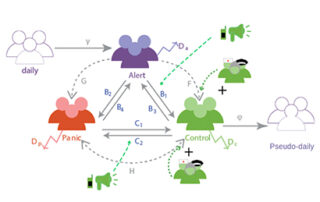
Study of the Effect of Rescuers and the Use of a Massive Alarm in a Population in a Disaster Situation
A study based on the mathematical model “alert, panic, control” (APC) inspired by models used in epidemiology.

Sustainability science framings and practices in Europe
Future Earth Autumn School 2023 will take place from 16 to 20 October at Aussois (France).

The new national museum of the history of immigration
The National Museum of the History of Immigration features a more evolutionary learning-centred approach and integrates recent research on immigration in France.

M/W – The CNRS recruits a PhD student in geography
The PhD candidate will investigate the link between zoonotic diseases and urbanization in India and Thailand.

Was Ukraine a colony of the Russian Empire?
In this video conference in Ukrainian, Ivan Savchuk talks about economic and social life in Ukraine from the late 18th to the early 19th century.

Recent changes and dynamics of housing practices in southern European metropolises
The latest issue of the Bulletin de correspondance hellénique moderne et contemporain, co-edited by Dominique Rivière.

Modalities of land use conversion linked to urbanisation in the South
Two publications on land policies and land markets and transactions, resulting from the work of the Land Tenure and Development Technical Committee co-chaired by the MEAE and AFD.

An empirical investigation to the rural-urban linkage in India
On monday 26th June at the Condorcet campus, this seminar will provide an opportunity to take stock of developments in the production and availability of datasets in India.

Form of knowledge, form of power
Jean-Marc Besse will present his book on 5 July at the Italian Historical Institute for the Modern and Contemporary Period (Rome).

When children move to middle school
How children’s autonomy evolves during a “normative transition” from elementary to middle school? A research supported by the National Research Agency in the frame of the Mobi’kids program.

Biogeochemical Cycles and Agricultural Recycling of Urban Organic Waste (Paris, 1940s–1990s)
A presentation of Étienne Dufour, invited by The Rachel Carson Center for Environment and Society.

Thesis defense: Achille Warnant
Achille Warnant will defend his doctoral thesis in geography on June 2 at 2pm on the Condorcet campus.

Intersectional approach of everyday geography
A new paper (from Mobiliscope data) published in journal "Environment and Planning B: Urban Analytics and City Science".

Library of the Universal Esperanto Association in Rotterdam transferred to the National Library
The ceremony will take place at the National Library in Warsaw on May 29 and will be followed by a seminar on the importance of Esperanto and the Hector Hodler collection.

Solidarity beyond the longest border
Danièle Bélanger will present "Solidarity beyond the longest border" on May 24 at the Condorcet campus.

Round the World Seminar
Explore issues related to individual mobilities that explicitly take the global space as a reference: June 1, at the Condorcet campus.

ARCS, network analysis journal in human and social sciences
The publication of this journal is part of the policy implemented by Géographie-cités to support and develop open science.

Municipal socialism and the impact of urban decay
This article proposes to examine the evolution of the local political field of Nevers (1971–2020) in the light of the social, economic, and demographic transformations of the territory.

Researchers and their data
A study based on the use of the word data in scholarly articles.

Memories of Les Tartres
This short film, produced by Géographie-cinés, presents the oscillations of the wastelands in the northern suburbs of Paris.

Choreographing the earth
Belonging and expressive ways of inhabiting it: Jean-Marc BESSE will speak at the "Night of Geography 2023", on April 14, in Ferrara (Italy).

Embodied geopolitics and negotiations of belongings from Turkey to Athens after 2016
How historical and political relations between Greece and Turkey ‘haunt’ the lives of Turkish citizens who came to live in Athens after 2016.

Athanasios Gekas, Guest researcher
Discover the teaching program of Anthanasios Gekas, guest professor at EHESS by Camille Schmoll in April.

The territorial dimension of health crisis – DITES
Dates: 2022 - 2024
DITES project's objective is to reassess and propose methods of cooperation between the territorial levels in order to define modes of governance that would allow us to anticipate and adapt to different crises.

Thesis defense: Gábor Oláh
Gábor Oláh will present his doctoral dissertation in urban studies on March 31 at 2 pm.

Everyday geographies, neighbourhood effects and urban segregation – Lunch seminar at TU Delft
On 30 March, with speaker Julie Vallée for the lunch seminar at the TU Delft (Faculty of Architecture and Built Environment).

Sous le Pavé, la plage
Screening/Debate on March 22 at 5pm at the Humathèque on the Condorcet campus.

Thesis defense : Natacha Rollinde
Natacha Rollinde will defend her thesis on March 20th at 2pm at the Auditorium of the Humathèque, Condorcet campus.

French Geography Through the Lens of Interdisciplinary, and Through Time
Monday, the 17th of april : online talk of Marie-Vic Ozouf and Nicolas Verdier, in the framework of EHESS Spring talks.

Urban History Lectures – Rosemary Wakeman (Fordham University)
March 10, 13 and 16 at the Condorcet campus.

Sabine Barles awarded the CNRS silver medal
Sabine Barles has been awarded the CNRS Silver Medal 2023 for her work on the interactions between cities and their environment.

Doctoral Days – Call for papers
Critical Perspectives on Development - Resilience (October 18-20, 2023). Submission of proposals by April 1, 2023.

Effects of housing asset deflation on shrinking cities
A predictive analysis dealing with the case of the Tokyo metropolitan area (2019 to 2045) from Sophie BUHNIK.

The local urban plan: an instrument for extending heritage protection?
This article written by Mathieu Gigot & al. is based on the results of a research project devoted to the notion of “PLU patrimonial”.

The evolution of social mix and segregation in Greater Paris
A round table about segregation in the Paris region, organized by APUR, Insee and Urban School of Science Po, with the participation of Julie Vallée (Géographie-cités).

Accelerating the Transition to Renewables in the Context of Multiple Crises
On February 14, at the Marc Bloch Center, round table with the participation of Gilles Lepesant.

Overcoming knowledge network failures
This article investigates the determinants of the formation of interregional scientific alliances through the in-depth case study of a federation of research laboratories in green chemistry in western France.

Migration as adaptation
Clara JULLIEN explores rural-urban migration in a context of environmental change, particularly from the Mekong Delta to Ho Chi Minh City.

Ontologies and spatial dynamics
Complementarity of symbolic and numerical approaches. Contributions of Géographie-cités to the special issue of the International Journal of Geomatics.
Learning from Territories / Teaching Territories
The call for papers for the 6th CIST conference is open until February 27, 2023.

Strategies for Building Good Research Questions through the Logic of Puzzles
Dr. Raul Pacheco-Vega, Associate Professor in the Methods Lab of FLACSO (México) will give a talk on January 30th at Campus Condorcet.

Higher Renewable Energy Targets in Germany
How Will the Industry Benefit? Gilles Lepesant in "Briefings de l’Ifri".

The material city
On February 3, at the Condorcet campus, a day to discuss the material approach to urban production. city materials soil

Public space and the metropolis
The changing governance of public spaces around the Grand Paris Express's new metro stations, by Antoine Fleury.

Thesis defense
Joséphine LECUYER will defend her thesis on Monday December 12 at the Condorcet campus.

Thesis Defence
Romain Leconte will defend his thesis in geography on December 13 at the Université Paris Cité.

Fifteen PhD students join Geography-Cities
Welcome to the new PhD students who have joined UMR Géographie-cités!

Gentrification by project
Public policies and the revalorization of pericentral neighbourhoods, the case of the MIL Campus in Montreal

The City Booster railway station: a phantom model for French metropolises?
An article by Marion Albertelli published in the latest issue of Géotransports.

Beyond the project: Tensions and negotiations in the planning of metropolitan station areas in Lyon and Rotterdam
Actors' strategies: deciphering with Mathilde Pedro.

Fanny COTTET winner of the Palladio scholarships
The Palladio Foundation rewards the innovative character of training or research projects related to urban and real estate issues.

Mapping LGBTQ Spaces and Places: A Changing World
LGBTQ issues addressed in relation to a variety of fields of study. With contributions from Clément Nicolle and Milan Bonte.

World Atlas of Sexuality
With more than 100 maps, this atlas provides a panorama of sexualities, drawing a new French, European and global geography.

Denis Eckert invited to Cafés Géo
Andreas Kappeler and Denis Eckert guests of Les cafés géographiques de Paris, November 15, at the Café de Flore.

Solomon Benjamin, guest researcher : lectures in November
Solomon Benjamin, guest researcher at the Géographie-cités' laboratory will give several lectures from october to november.

PhD defence
Cinzia LOSAVIO will defend her thesis in geography and planning on November 9 at the Condorcet campus.

Monthly seminars of the fmr group
The fmr (flows, matrices, networks) group resumes its monthly seminars. Next meeting: November 8, Campus Condorcet.

Thesis defense
Anne-Cécile Ott will defend her thesis "Coming into the world: sociogenesis of children's ways of representing world space" on October 21 at the Condorcet Campus.

Web workshops
Four workshops will be organized in the fourth quarter of 2022 to learn how to use the administration interface of the Geographie-Cités website.

Trade-offs between sustainable development goals in systems of cities
Why there is no single urban optimum, but a diversity of regimes forming a compromise between contradictory sustainable development objectives.

Lost in transformation
A comparative analysis of healthcare provision dynamics within urban systems ofEuropean Russia and France.

“It’s a three-way ring”: E-hailing platforms, drivers and riders reshaping Accra’s mobility landscape
A multi-faceted account of how e-hailing platforms have blended into the system of actors who operate urban mobility in Ghana’s capital Accra.
Launch of the SPACE research program
Developing a dynamic and adaptive approach to urban sustainability in the context of Singapore's Smart Nation initiative.

OCEANLINKS
Dates: 2022 - 2025
The aim of the OCEANLINKS project is to trace back the origins of scientific marine stations and the ties that have developed between them over time, helping to link oceans and ocean knowledge on a global scale.

World History of the 20th Century
Tamara Boussac is the author of the chapter "Beyond the 'American Century': North America in the 20th Century" in this collective work.

Population behaviors and evacuation management during disaster
An analysis of the effects of territory properties on population behaviors and evacuation management during disasters using coupled dynamical systems

On the Role of Space, Place, and Social Networks in Social Participation
The latest issue of Social inclusion, devoted to the role of space, place and social networks in social participation, coedited by Marion Maisonobe.

PARIS seminar
Next seminar in PARIS, September 23rd at Campus Condorcet and in distance learning.

Five new members join Geography-Cities
Sylvestre Duroudier, Adèle Esposito, Hugues Pecout, Aurélien Ramos and Djemila Zeneidi have joined the UMR Géographie-cités.

The war in Ukraine
"Urban memorial and monumental spaces contested": a round table moderated by Marie-Vic Ozouf Marignier on October 19.

Festival international de Géographie de Saint-Dié
Geography-Cities participates in the international festival of geography of Saint-Dié-des-Vosges on September 30th, October 1st and 2nd.

Municipal merger in France (2012-2022)
A methodology for data analysis at municipal level with moving boundaries.

European Memories of the Gulag
The history of the Stalinist deportations via thematic and biographical presentations, research articles and maps.

Russians and Ukrainians, unequal brothers
A long-term perspective on the first European war of the 21st century.

Form of knowledge, form of power
Geographical atlases in the modern and contemporary period, studied in their political and cognitive functions. To be published in September 2022.

Cities at the Heart of Inequalities
How are inequalities produced and reproduced both within and between cities?

LAPTER
Dates: 2022 - 2025
The research project LAPTER (Heritage and Tourism Labels in the Centre Val de Loire Region: a TERrritorial resource?) aims to answer the following question: what is the purpose of labels for heritage and tourism development? More precisely, it will look at whether - and to what extent - these labels are tools for territorial planning and local development.

Network analysis and graph theory: the text collection
The collection of texts of the fmr group offers bilingual and commented versions of texts related to network analysis.

A social history of quantitative geography in France from the 1970s to the 1990s
An overview of the blossoming of a multifaceted tradition, by Olivier Orain, a member of Géographie-cités.

Urban restructuring, property development and changes in cityscapes
The IGU’s Urban Commission workshop, Paris, from 23 rd to 27 th July 2022.

Landbased commons for housing in the Global South
Results of the research program led by Géographie-cités.
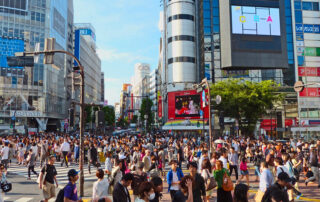
Public spaces of mobility in Paris, Tokyo and Buenos Aires
A workshop on Design, management, and governance for a social and post-pandemic transition, with Natacha Aveline-Dubach, on July 5th. Online.

Socio-ecological practices in urban metropolises
The 5th session of ESPACES MOB seminar will take place on June 20th at 2:00 pm (Paris time), only on visio-conference.

Day of scientific tribute to François Durand-Dastès
A day dedicated to the scientific legacy of François Durand-Dastès at the Curie Museum and the Institute of Geography on June 18.

Financializing nursing homes?
The article Of Natacha Aveline casts light on current debates on the political economy of real estate financialization.

50 years of the UNESCO World Heritage Convention
Achievements and Challenges in Europe The UNESCO World Heritage Convention [...]

Four lectures by Sander vander Leeuw
In June, four lectures will be given remotely by the archaeologist and historian Sander van der Leeuw.

Nicolas Verdier, visiting professor at the University of Chile
This specialist in the epistemology of knowledge on spaces and territories will give two conferences, in Santiago on 8 June and in Punta Arenas on 15 June.

Rethinking a research project in a war context
As part of the conference "For a Europe of Humanities and Social Sciences", June 15, in Paris, Denis Eckert's lecture.

Representing globalization through flows
How world maps show a relational geography of globalization, by Françoise Bahoken.

Tourism in Isfahan Province, Iran
How tourism can be the source of ideological tensions regarding the practices and places it invests.

Regioviz, a geovisualization tool to position the French regions in Europe
How to facilitate territorial comparisons thanks to an interface designed as close as possible to the users' needs.

WIsDHoM programme: closing seminar
Property inequalities and housing market dynamics: closing seminar, 27 June.

Post-revolution structuring and recompositions of a globalised trade route in Tunisia
Diachronic analysis of the routes taken by the flow of goods made in China supplying the markets of Tunis.

Seeing the world as a landscape
On the occasion of this conference, Jean-Marc Besse, hosted by UNSAM (Argentina) will present his book Habitar on 17 May.

Clément Gaillard’s thesis defence
Thesis defence: Clément Gaillard will defend his thesis on 24 May at the Centre Panthéon Sorbonne.

Handbook of Research on the Global View of Open Access and Scholarly Communications
From Open Access Publishing to Open Science: An Overview of the Last Developments in Europe and in France

An application to conduct augmented interviews
Presentation of the results of using AMPLI software to prepare interviews with users of a streaming platform.

Living in Transition
How do real estate actors and markets deal with climate change? Workshop, 18 May in Montpellier.

The Crimean bridge(s) before 2014
Two researchers, one French, the other Ukrainian, analyze the genesis of the Crimean Bridge and its strong link with the war.

Housing Production
Conference by Thibault Le Corre at the French Institute for Research on Japan on Tuesday May 10.

Living in small and medium-sized cities: call for papers
Living in small and medium-sized cities: social relationships, residential paths [...]

IGU Urban Commission Workshop
(Re)Thinking Cities and the Urban: From Global to Local: IGU Urban Commission Annual Conference, 23-27 July.

Mobiliscope: a new version including three Latin America cities
Bogotá, Santiago and São Paulo are now included in Mobiliscope, in addition to the 55 French and Canadian cities already avalaible in the tool.

Series of lectures by Federico FERRETTI
Cycle of lectures by this associate member of Géographie-cités, on 21 April, 16, 18 and 20 May.

For Ukraine: analyze in the moment
On April 15, round table at the Condorcet Campus, with the participation of Denis Eckert, member of Géographie-cités.

The red line: Milan and its first subway (1964)
Barbara Carnevali will present on April 14, 2022 the Red Line, Milan's first subway line, a symbolic system in its own right.

A gayer city?
« Zero feet away », slogan de Grindr et [...]

Migrants and the city. A comparative perspective
EHESS Spring Talks, 28 March: virtual round table with Camille Schmoll and Beatriz Fernandez.

LASA Prize for the best book on Brazil in the humanities
A prize from the Latin American Studies Association awarded to Larissa Alves De Lira, associate member of Geography-Cities.

Public spaces and mobilities
A book that gives full meaning to the experience of passage as an unexpected matrix of the space in societies, through which commons are established and broken.

A struggle for space
Andrea Kocsis, will speak on April 7 about the commemoration of the First World War in capital cities.

The urban fact in Japan, historical and contemporary perspective
Natacha Aveline, visiting researcher at the University of Montreal, teaches a course on the urban fact in Japan.

Mobilities and Territories in the light of the Covid-19 pandemic
"From the World Before to the World After": Geography-Cities explores the spatial dimensions of the pandemic phenomenon.

For Ukraine – a scientific and solidarity event
On April 15, a day of debate at the Centre de colloques du Campus Condorcet, with the participation of Denis Eckert.

Figures of a geographer: Paul Vidal de la Blache (1845-1918)
Discover the virtual exhibition on one of the inventors of geography in the early 20th century and the leader of the French school of geography.

The cacophony of Donbass
In echo to the war in Ukraine, screening on March 23 of Igor Minaiev's documentary at the Marc Bloch Center and discussion with Denis Eckert.

Scientific publishing: Cybergeo co-signs the European open access diamond action plan
Cybergeo, the first electronic and open access scientific journal in SHS, hosted by Géographie-cités, a stakeholder in the European Diamond Action Plan.

The anchoring of companies in the city’s political districts
Thesis defence: Clara Hercule will present her thesis on 25 March at the Institute of Geography (Paris).

Urban public spaces: thinking, investigating, making
A book that re-explores urban public spaces using a variety of questions, fields and methods.

Since when has geography been a “social science” in France?
Reflections on the progressive institutionalization of the "SHS" since 1945: conference by Olivier Orain on March 31.

Thinking space beyond the binary: critical feminist and queer approaches
Call for papers for the 6th edition of the European Geographies of Sexualities Conference. Deadline: March 27th, 2022

Retrospective Mapping
Retrospective mapping workshop led by Sandrine Robert at the University of Ottawa on April 1st.

New in the Encyclopedia SCIENCE
Latest publications of the "Geography and Demography" field directed by Denise Pumain.

Models of interdisciplinary and (inter)national collaboration
March 10 at 2:30 pm at the Condorcet Campus, lecture by Niki Vermeulen, guest researcher of the Geographie-cités laboratory.

Cities and Research
See you on March 18 at the next Géographie-cités seminar at the Campus Condorcet.

DoCAF, a Tool to explore data from the Family Benefits Agency in Ile-de-France
Luc Guibard and Bruno Fayard present DoCaf, an online tool for visualising data from the family allowance funds of the Île-de-France region.

Scientific Congresses and Scholarly Networks
Find the report of the conference as well as the slides and abstracts of the presentations.

Niki Vermeulen, guest professor – March 2022
Niki Vermeulen is guest professor at Géographie-cités.

Declaration by the International Geographical Union on the Ukraine crisis
The Geography-Cities laboratory fully associates itself with the declaration of the executive committee of the International Geographical Union on the situation in Ukraine.

Russians and Ukrainians: ‘unequal brothers’?
A geo-history of the relationship between Ukrainians and Russians, as a commentary on the essay (2016) by historian Andreas Kappeler: lecture by Denis Eckert, March 3.

When urban transformation becomes gentrification
Dilruba ERKA will defend her geography thesis on February 25.

Contribution of archaeogeography to address urban issues
Landscapes and urban fabrics as resilient adaptive systems: the contribution of archaeogeography. Conference by Sandrine Robert at the University of Montreal on March 29.

Migrants and the city. A comparative perspective
March 28 at EHESS Spring talks with Camille Schmoll and Beatriz Fernandez for a roundtable discussion "Migrants and the city. A comparative perspective".

IGU’s Urban Commission call for papers
Annual Conference of the Urban Commission of the International Geographic Union, University of Paris, July 23-27, 2022.

EHGO Seminar
Benjamin Duinat, new associate member of Géographie-cités, invited to the EHGO seminar on February 18.

Soylent green, this dystopian future that threatens us
On February 17 at 8:00 pm at the Latin Quarter film library, you will be able to (re)see the great science fiction classic, Green Sun by Richard Fleischer, presented by Alain Musset.

What rights to the city?
Conference by Anne-Christine Trémon (University of Lausanne) on February 18 at the Condorcet Campus.

Digital nomads: ubiquity, work & leisure summary
See you on February 25 for the second session of the "Around the world" seminar, co-organized in the framework of the "Mobilities and Spaces" working group of Labex Dynamite.
The Ecological Tradition of French Geography
Dylan SIMON will speak on February 18 at the "History of Humanities and Social Sciences" seminar.

An “à la carte” city
Thesis defence:Ulysse LASSAUBE will present his doctoral thesis in Geography on February 24 at the Paris City Hall.

“The world is us”
Thesis defence: Nolwenn Azilis Rigollet will submit her doctoral thesis in Geography on February 16, 2022.

Housing and Housing Policies
From February 21 to May 30, 2022, at the Condorcet Campus, a seminar on housing policies that will alternate debates and workshops.

Geography of Health Meetings
3rd Health Geography Meeting (26 -29 May 2022, Cannes): send your abstracts before 14 February 2022!
Call for papers for the IGU 2022 Urban Commission International Workshop
Call for papers for the IGU 2022 Urban Commission International Workshop. Deadline for submission of abstracts: February 15, 2022.

Dissecting Cohesion and Fragmentation in Beirut through the Interface lens
Thesis defence: Nisrine Mezher, will defend her thesis on January 18th from the Lebanese University.

Europe, a region of the world: research seminar
From February 3 to 4, a few insights into the current state of research in geography concerning the European continent.

UGI Colloquium: sessions on real estate
UGI/IGU Colloquium July 18-22, 2022: abstract submission date for two sessions on the field of real estate postponed to January 18.
Seminar PARIS
On the agenda of the PARIS seminar on January 21: meeting on Grindr; bicycle mobility in peri-urban areas.

Lectures by Ana Maria Alvarez Rojas, visiting professor
Ana Maria Alvarez Rojas is a professor at the Center [...]

Resilience: Persistence and Change in Landscape Forms
This work considers landscapes as complex resilient adaptive systems and as the result of a dynamic fed by a constant dialogue between persistence and change.

Centenary of Emmanuel de Martonne’s great excursions in Romania
An exhibition dedicated to the field notebooks of Emmanuel de Martonne. From December 13 at the library of geography of Paris.

When migrants produce the city: Everyday negotiations of urban space
Through the examples of Paris, Lima, Izmir (Turkey), Mexico City and Tijuana, this issue explores the capacity for action of migrants and their contribution to urban life.

Anglophone Geographies, New Challenges
A collective work that aims to provide keys to understanding key trends in Anglophone geography.
Islands at the crossroads of new mobilities: call for papers
Call for papers for the session "Islands at the crossroads of new mobilities" of the IGU conference. Deadline: January 11
Death of François Durand-Dastès
François Durand-Dastès, geographer and eminent climatologist, died on December 28, 2021.

Migrants : faces and paths of migration
From January 19 to 23, 2022 Ground Control gathers and welcomes the paths and faces of migration.

Space, gender and sexualities: where are we at?
Call for papers for a session of the IGU Colloquium - Deadline: January 11, 2022

An Atlas of Geographical Wonders: from Mountaintops to Riverbeds
The World on a Leaf (1st French edition by Fage in 2014) has just been published in a Chinese translation and edited by Beijing Highlight Press Co., Ltd.

Settling the World: from Prehistory to the Metropolis Era
This book proposes a method for understanding the laws of human settlement in the very long term.

Social housing organizations facing urban shrinkage
Thesis defence: Marie Mondain on December 14.

Workshop for PhD students: open science and its challenges for your thesis work
First Open Science webinar-workshop for PhD students on December 21 at 2pm.

Renewing city-countryside relations and the socio-ecological transition: what perspectives for metabolism?”
Thesis defence: Laetitia Verhaeghe will defend her thesis on December 16.

Qualitative demography of the urban experience of children of rural migrants in southern China
Camille Salgues (South China Normal University) will present on December 3 a demographic study on the children of rural migrants in southern China.

Air pollution and climate
Exclusive interview with François Durand-Dastès, specialist on India and recognized climatologist.
Death of Thérèse Saint-Julien
Thérèse Saint-Julien, one of the great figures of creative women in geography, passed away on November 24.

Transnational cooperation between European cities
Thesis defence: Paul Gourdon will defend his thesis in geography on November 30.

Colony without a Flag: Imperial Cartographic Strategies at the Margin of the Peace Conference Mapping, connectivity
The second volume of a three-volume series devoted to the production of imperial spaces and their relation to geographical imaginaries.

Blade Runner Weekend
Alain Musset, geographer, reveals the dark side of the cities of the future during a conference: "Blade Runner and Los Angeles: autopsy of the cities of the future.

UGI – IGU 2022 Paris
The Paris 2022 UGI Centennial Congress will take place between July 18 and July 22 2022.

Contemporary metropolises: imagining and inventing futures
With the massive emergence of dystopian fictions, a look back at Fritz Lang's masterpiece Metropolis sheds light on possible futures.
Scientific congresses and scholarly networks
On December 8, a study day at the crossroads of geography, history, sociology and information sciences.

In search of light
A little girl plays in a net of light between two "kissing buildings" in the heart of an urban village in Guangzhou, Guangdong province, China.

Transnational Property in Southern Europe
On November 18 and 19 at the French School of Athens, a colloquium co-organized with Géographie-cités, in the framework of the Metropolises program.

Thinking from the landscape: carte blanche to Jean-Marc Besse
Opera Mundi gives carte blanche to the philosopher and landscape historian Jean-Marc Besse to inaugurate on November 12 and 13 its new season of conferences 2021-2022.

Influence of recommendation on music content consumption
A study which highlights the nontrivial effects of platform-mediated recommendation on consumption.

Seeing the Earth: six essays on landscape and geography
A spiritual, literary, aesthetic, philosophical and scientific overview by Jean-Marc Besse, philosopher.

The metabolism of the Parisian agglomeration
The impact of societal choices and environmental changes on Paris and its basin, a PIREN Seine booklet, edited by Sabine Barles.

Science Vs Lobbying: Total, Elf and Climate Change
An article by François Durand-Dastès, a member of Géographie-cités, at the center of a study showing that TotalEnergies, although aware of the risks induced by climate change as early as 1971, cast doubt on the scientific data that threatened its activities.

The path of urban development in Datong (China)
A photograph by Cinzia Losavio, taken from a building under demolition in the city of Datong, Shanxi province, China.

Thesis prize of the French National Committee of Geography
The first thesis prize of the French National Committee of Geography has been awarded to Julien Migozzi.

London-Paris survey
The Université de Paris has partnered with King’s College and Ipsos on research into the UK and French capitals.

2021 Dissertation Prize for the study of Cities
The 2021 Dissertation Prize for the study of Cities PUCA/ [...]

Welcome to the new PhD students!
Eight PhD students have just joined Geographie-Cités.

Progressive housing improvement programs in debate
A quantitative and spatial analysis of housing investment by poor [...]

Daily life in an urban village in Zhuhai, China
Cinzia Losavio examines the spatial, social and architectural complexity of urban villages in Zhuhai.

Interview with Camille Schmoll
In this interview for the #AllezSavoir2021 festival, geographer Camille Schmoll looks back on her career and her research themes: migration in the Mediterranean and gender in migration.

Épopées, the Condorcet campus festival
Campus Condorcet Festival, 30 September to 2 October & Fête de la science, 1 and 2 October.

Exposition CNRS
An exhibition on research careers, from October 5 to 20 at the Condorcet campus.

Hybrid Mobilities: Transgressive Spatialities
The diversity of mobility situations studied in this book highlights the contribution of the reality of mobility in the daily construction of urban, regional, and global spaces.

Everyday geography and service accessibility
A new article about everyday geography of young adults and the unequal importance that spatial accessibility to a range of urban services might have for their mental health.
LimSpaces – Living with uncertainty. Strategies of adaptation and horizons of expectations in Ukraine and Moldova
Dates: 2021 - 2024
The project offers a new interpretation of the societies of Ukraine and Moldova. The originality of the project lies in looking at the microsocial effects of the "in-between" position of these populations, caught between Western and Russian spheres of intervention. It analyzes them from an actor-centered, grounded and relational perspective.

Immigrants in rural France: small numbers but increasingly diverse origins
How many immigrants live in rural France today?

Dictionnaire critique des mobilités
A tool providing an overview of concepts and methodological approaches in the study of mobilities.

Géographie sociale: Approches, concepts, exemples
This book, a true introduction to social geography, presents the principle theoretical contributions, the broad concepts, and the methods.

Nommer les savoirs. Revue d’histoire des sciences humaines n° 37
“Nommer les savoirs” is the thematic dossier of the latest issue of the Revue d'histoire des sciences humaines.

Max Sorre, une écologie humaine : penser la géographie comme science de l’homme
This biography, the first on the subject, traces the life of Max Sorre, a pioneer of ecological thought.

From Data to Platform: Geohistory in OpenAccess
From data to open access geohistorical platforms A week of exchanges around the issues and modalities of geohistorical data deposit.

New Arrival: Catherine Côme, Communications
Catherine Côme joined UMR Géographie-cités in May 2021. Her mission is to manage and implement the UMR's internal and external communication policy.

SHS Chairs Juniors: Apply before July 12!
The Ile-de-France Region has set up a system of Junior Chairs in the Social Sciences and Humanities, which enables young, employed researchers to finance their research projects.

Arts and Sciences of Complex Systems Day: Call for Participation
Does producing the city with reduced financial resources involve innovations that open the way to an alternative conception of the urban? Submit your proposals before June 30, 2021, to participate in ARTEX!

Producing Cities Without Financial Resources
Does producing the city with reduced financial resources involve innovations that open the way to an alternative conception of the urban?

The First Results of the GlocalMap Survey
Carried out by GIS-CIST in partnership with UMR Géographie-cités and UMR IDEES, the GlocalMap survey aims to provide a first snapshot of the status of the French populations’ perceptions of relevant territorial levels.

Exchange and Proximity: The First Law of Geography
This MOOC provides an opportunity to become familiar with the observation of exchange flows between places, to develop a better understanding of modelling compared to maps that may seem inextricable, and to learn how to use the gravity model to understand exchanges and interactions in the spatial organization of societies.

Networks for Understanding the World
At the end of this course, you will be able to describe how networks are designed and organized to develop a territory, state some basic principles of graph theory and make simple measurements, and explain the results of their application in many areas where they are used today.

Global City Systems
At the end of this course, you will have a global vision of what determines the diversity of cities in terms of size, economic activity, social composition, and landscape and cultural variety throughout the world. You will have the keys to understand the scope for actions that contribute to their evolution. You will have a clear awareness of the richness associated with urban diversity in terms of possible solutions for the sustainability of development and “living together.”

Upgraded version of the Mobiliscope
A new version of the tool went online on April 8, 2021. 26 French metropolitan and overseas areas were added to the 23 French and the 6 Quebec city regions already present.

Carlo Salone, guest professor
Carlo Salone, Professor of Political and Economic Geography at DIST (Politecnico di Torino and University of Torino) is invited by Marie-Vic Ozouf-Marignier.

Thesis Defence: Chloé Reiser
Thesis defence: Chloé Reiser, February 15, 2021.

HDR Defence: Thomas Pfirsch
“Les espaces de la parenté en mouvement. Parenté transnationale et nouvelles migrations italiennes”

HDR Defence: Sandrine Robert
“La résilience: un cadre pour penser la persistance et le changement dans les formes du paysage”
Emmanuel de Martonne Corpus. Phase 2
Dates: 2021 - 2022
Phase 2 of the project, within the framework of Digital Humanities, promotes a second body of archives by geographer Emmanuel de Martonne (1873-1955) consisting of 6 field notebooks and 400 glass plates. As for phase 1, phase 2 analyzes, documents, archives and disseminates the archives according to a threefold problematic: that of the geographical heritage of textual and iconographic sources, that of Open Science and that of innovation in Human and Social Sciences.

DESIGNSHS. Graphic Design, Research, and Social Science Heritage
Dates: 2021 - 2025
The program aims to study and valorize the archives of the laboratory of cartography, then of graphics, directed by Jacques Bertin from 1954 to 1985 (EPHE then EHESS). The aim is to explore, from this major source, the relationships that were established between graphic creation and research in the human and social sciences in the second half of the 20th century.

Thesis Defence: Anaïs Dubreuil
Anaïs Dubreuil defended her thesis on 15 December!

Study Cycle: Urban Experimentation
Study cycle "Urban Experimentation" (organization: Marion Albertelli, Fanny Cottet, Natacha Rollinde and Mathilde Pedro)

LIU Chun-Ya Defended Her Thesis
Chun-ya LIU defended her thesis on Wednesday, September 2, 2020, at the Centre Sorbonne.

Recruitment of Mathieu Gigot
Mathieu Gigot joins University of Paris as Associate Professor of Spatial Planning and Urbanism

Social housing sales in the Paris region: Social housing organizations & their tenants facing the Parisian housing market
Dates: 2020 - 2023
In France, social housing sales have been promoted by public officials since the 1980s in order to improve households’ housing trajectories and to contribute to the financing of new social dwellings. The project analyzes the housing past and futures of households living in social buildings offered for sale and assesses the way sales changes social housing management and production.
Land conversion for urban uses in the global south
Dates: 2020 - 2021
This collective research focuses on the modalities of land use conversion in the Global South in relation to urbanization. The aim is, on the one hand, to identify and classify the conversion processes, the exits from agricultural use or the entry into the urban market on a macro scale and, on the other hand, to document the modalities of action and their effects on the basis of specific case studies.
DiffusEsperanto – Documenting the multilingual dissemination of a universalist project at the end of the 19th century: the digitization of the early writings of the Esperanto movement (1887-1892)
Dates: 2020 - 2021
As soon as Esperanto appeared in 1887, its promoters developed a multilingual propaganda to popularize this "international language". The project is to digitize the booklets published in several "natural languages" between 1887 and 1892 to promote Esperanto, documents scattered in European and Israeli libraries, and thus constitute a corpus for the analysis of the early diffusion of the Esperanto idea.
A sky still divided? Germany’s East and West, thirty years after reunification
Dates: 2020 - 2021
The project questions the observable differences between East and West German societies 30 years after reunification. It is based on ethnographic surveys conducted by Franco-German teams, returning to the thesis work of two anthro-pologists who had studied in the 1990s villages located in direct proximity to the former Iron Curtain.

MobiTIC
Dates: 2020 - 2024
MobiTIC is a collaborative research program that gathers public research institutions (CNRS, IFSTTAR), the national statistics bureau (INSEE) and the main mobile network operator in France (Orange). We aim to develop a reproductible methodology to produce representative indicators of people presence and mobility, frequently updated and at very fine spatial and temporal scales.
Cartography of the exile in the Stalinist USSR
Dates: 2020 - 2021
The project is working on a cartographic representation of deportation trajectories and "special colonies" where, during the time of the USSR, entire population groups (about 6 million people) were relegated. A feasibility study is being carried out here for three control territories with a view to a generalisable approach for the whole of the USSR.

RECORDS
Dates: 2020 - 2024
Through this project we aim to better understand the diversity of individuals musical taste, listening practices and effective music consumptions on streaming platforms. We develop indicators measuring the effects of recommendation (human and machine) on the listening history of users. To fulfill these objectives we combine traditional survey methods with big data analysis. The program is based upon a partnership between social scientists, computer scientists and one of the major music streaming platforms in France.

ANR-DFG Imageun – In the Mirror of the European Neighbourhood (Policy). Mapping Macro-Regional Imaginations (2020-2024)
Dates: 2020 - 2024
The aim of this Franco-German research project is to analyse the specifically geographical dimension of the imaginaries that animate regional integration in this part of the world, by crossing the analysis of textual and iconographic corpuses, in order to identify and study the regions of the world to which the populations of five countries occupying different situations in the region feel they belong: Germany and France, Turkey, Tunisia and the United Kingdom.
Circulation, geopolitics and the construction of knowledge about the world from the straits. The case of a world passage, the Strait of Magellan
Dates : 2020 - 2022
The project analyses the role of straits in the organization of political spaces on a global and regional scale in the modern period, and in particular examines the role of the Strait of Magellan in the processes of circulation of knowledge and narratives that linked Europe to the American continent. Other straits are studied in a comparative way (Gibraltar, Bosphorus, Malacca).

The CRIA team welcomes Denise Bomtempo
The CRIA team welcomes Denise Bomtempo, Professor of Geography at the State University of Ceará, Brazil.

Introduction to Network Analysis with R
November 19 and 26, 2019 in Paris
Géotéca (ex Pôle Image, Université Paris 7), the transversal axis “Data and Protocols in Digital Humanities” (UMR Géographie-cités) and the GDR Analyse de réseaux en SHS offer a two-day training course devoted to network analysis with R.

Introduction to Network Analysis
October 15 and 16, 2019 in Rennes
The GDR Analyse de réseaux en sciences humaines et sociales, in collaboration with the Réseaux et Histoire group, offers two days of initiation to network analysis. This training is followed by the fifth Réseaux et Histoire meeting.

La Butte Pinson
The Butte Pinson, from an overgrown quarry to a regional green space. Field trip on 4 October 2019 to the Butte Pinson (Organized by: Cécile Mattoug)

Journée d’étude Looking for locations, research sites
The first journée d’étude organized by the transverse subject “Data and Protocols in Digital Humanities” with the support of the INFTER axis of the CIST and the Pôle Image was held in Paris.

Financing Clean Air
Dates: 2019 - 2023
The Financing Clean Air project brings together researchers from Europe and China to explore how Land Value Capture (LVC) might be used to support the goal of improving air quality in urban environments. The project takes a specific focus on the impacts that transport and housing, particularly domestic heating, have on air quality.
Governing Diverse Cities in Europe and Asia
Dates: 2019 - 2021
Cities in Europe and Asia have become the focal points of changing migration patterns. This context has challenged pre-existing models of management of urban diversity. In parallel, the rise of nationalist rhetoric feed the implementation of a number of exclusionary measures. This comparative projects contemplates the city as a key site to on emerging models of diversity governance.
MOREHOUSE (Modeling hOusing maRkets dynamics thanks to Emerging and HeterOgeneoUs data SourcEs)
Dates: 2019 - 2021
In this exploratory program in partnership with IFISC (Palma, ES) we uncover the structure of real estate agent networks that can be identified from ad data posted on platforms (SeLoger, LeBonCoin, Idealista, FotoCasa). The data are represented using bipartite networks linking agents and ads. The methods used are those of spatial networks science and community detection in ecological networks.
PaMIzMex When migrants in transit produce the city. Crossed views between Paris, Milan, Izmir and Mexico City
Dates: 2019 - 2021
To specify the power relationships at work in the deployment of migrant spatialities. To characterize the forms of presence/visibility of migrants in transit in the city in a relational approach to public spaces. Study the daily interactions with other urban actors, inhabitants, tourists, institutional actors. Overcoming dualisms by articulating the times of mobility and anchorage.

CybergeoNet
Dates: 2020 - 2021
Starting from the specialized vocabulary of geography, the project aims to develop a protocol adaptable to other disciplines in the humanities and social sciences. The aim is to systematize experimented actions in terms of translation, to promote the translation of metadata (English, Spanish, Chinese), to develop multilingual indexes that will be shared with other open access journals.

POPSU Lille – The Lille metropolis and the others: cooperation for innovation?
Dates: 2019 - 2022
The project aims at analysing the way metropolises – and in particular the Métropole européenne de Lille – are embedded in complex territorial systems, made of other cities, rural areas, in and outside France. It is based on the characterization of the relationships between the metropolis and other territorial entities close to or far from it. It addresses urban metabolism in its extraterritorial dimensions.
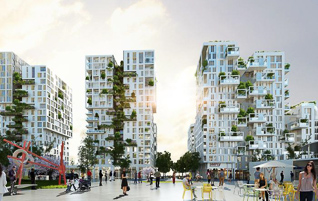
The land development and property activities of transport infrastructure managers: issues, processes and outcomes on urban production in Paris city-region
Dates: 2019 - 2022
The Firminfra project studies the land and real estate activities of two transport operators (Paris Aéroport and Société du Grand Paris) and the role of these actors in urban production in Île-de-France. The research describes the progressive diversification and evolution of the land and real estate activities of the two operators, analyses the logic underlying these changes and explores the outcomes of their activities on urban transformations of Paris city-region.
NETCONF “Scientific Networks and Congresses”. Understanding the effect of congresses on the dynamics of scientific networks
Dates: 2019 - 2021
The aim of this project is to characterise the effect that congresses can have on the dynamics of scientific networks and their internationalisation. To improve understanding of the social depth of scientific activity and the role of congresses in the circulation of knowledge and collaboration, NETCONF proposes to compare the case of two congresses in two disciplines: chemistry and political science.
NETSCITY “Analysing and visualising interurban scientific networks”
Dates: 2019 - 2021
This project aims to develop a platform for geospatial exploration of science data. The objective is to make available through an open access platform different options for processing and visualizing spatialized networks of contemporary science.

WIsDHoM – Wealth Inequalities and the Dynamics of Housing Market. Interpreting real-estate market-based regime of spatial inequalities
Dates: 2019 - 2022
The project investigates how asset-based welfare policies, residential market volatility, stratified accumulation and vulnerability impinge upon the geography of inequality in property markets. Since the 1990s, housing prices have increased faster than the income of buyers, becoming a driver of social polarisation and household vulnerability. We investigate links bteween socio-spatial inequality, asset capitalisation, instability and vulnerability in residential housing markets.
Inter-Friches – International and interdisciplinary workshops on urban wastelands
Dates: 2019 - 2021
Urban vacant lots, or wastelands, defined as transient spaces omnipresent in the city, became over the years a novel object of study in many disciplines (urban planning, geography, sociology, ecology). The workshops that we propose aim to define an interdisciplinary methodology to characterize wastelands’ in a systematic and transdisciplinary way.
Ties and interactions between the Condorcet university campus and the local community
Dates: 2019 - ...
This research intends to question the local impacts of university campus' construction by analyzing the case of Campus Condorcet. We aim to better comprehend how local stakeholders perceive, promote or contest present and future urban transformations. This project is based on a collective research with students of EHESS from different disciplines.
Com2SiCa research program (Understanding and Simulation of Human Behaviors in areas affected by disasters: from analysis to policy making)
Dates: 2018 - 2021
The Com2SiCa research program (Understanding and Simulation of Human Behaviors in areas affected by disasters: from analysis to policy making) aims to improve understanding and the ability to anticipate individual and collective human be-havior in face of complex threats and disasters of all origins, breaking down traditional disciplinary approaches.

Encyclopedia of Sciences Geography-Demography field
Dates: 2018 - 2025
Conception and writing of about 80 books presenting the knowledge and know-how of geography and demography for students and researchers (master and doctorate level) as well as for the general public. The books will be published in French by ISTE and in English by Wiley.

POPSU program – Rouen Normandy
Dates: 2018 - 2021
The "POPSU - Rouen" program is a collective research project involving public policy stakeholders and research teams. The scientific project focuses on three issues: metropolitan cooperation, accessibility and mobility, and metropolitan agenda for ecological transition. The research of the UMR Géographie-cités focuses more specifically on the analysis of the trajectory of public policies in the field of metropolitan cooperations and in the field of mobility.
The world seen from Kazakhstan ; exploration of world representation from an in-between space
Dates: 2018 - 2020
A previous survey (EuroBroadMap, 2009-11) concluded that Central asia was a blind sport in mental representation of world regions. This result could be explained by a methodological bias: the drawn regions are centered on the respondents, yet no survey had been carried out in Central Asia. To answer this question, the survey was replicated in 2018-19 in Kazakhstan.

Mobiliscope – Cities around the clock
Dates: 2017 - 2025
Places are not the same at night and during the day : people move daily and make changes in neighbourhoods densities and their social structures. Mobiliscope is a geovisualization platform to explore how areas and segregation change over a 24 hour period.
H2020 Odycceus (Opinion Dynamics and Cultural Conflict in European Space)
Dates: 2017 - 2020
Oddyceus seeks conceptual breakthroughs in Global Systems Science, including a fine-grained representation of cultural conflicts based on conceptual spaces and text analysis, game theory, and new models of alignment and polarization dynamics. It develops an open modular platform, PENELOPE, that integrates tools, from data scraped from social media and digital sources, to visualisation of the analyses and models.
Land-based commons for housing in the Global South
Dates: 2017 - 2020
To what extent can the “commons” approach contribute to the renewal of housing policies and programs? What is the feedback from the field of collective, cooperative, or commoning housing projects in Global South's cities?
Based on the notion of “commons”, this research scrutinizes forms of land tenure that are alternative to private ownership and guarantee land security in precarious neighborhoods.
Metropolises – Crisis and mutations in the Euro-Mediterranean space
Dates: 2017 - 2021
The program, led by the Ecole française of Rome (EFR) in collaboration with the Ecole française of Athens (EFA) and (until 2019) the Casa Velazquez (Madrid), questions the effect of the 2008 subprime crisis and the austerity policies on the Euro-Mediterranean in a trans-scalar perspective, based upon disciplines concerned with territorial issues (geography, planning, sociology, etc.). It is based on scientific meetings, doctoral training workshops, and publications.
Emmanuel de Martonne Corpus. Phase 1
Dates: 2017 - 2020
This project promotes the archives of the French geographer E. de Martonne (1873-1955) within the framework of Digital Humanities. The corpus of 7 field notebooks and 800 glass plates is analyzed, documented, archived and disseminated according to a threefold problematic: that of the geographical heritage of textual and iconographic sources, that of Open Science and that of innovation in Human and social Sciences.
RelatHealth- A relational approach to place effects on health in cities
Dates: 2018 - 2021
In RelatHealth project we propose to analyse place effects on health focusing on accessibility to various urban resources, such as health care facilities but also commercial, cultural, transportation and leisure facilities. We aim to reconsider the notion of accessibility combining not only spatial distribution of urban resources but also people’s place experiences and to explore inequalities in resources accessibility may translate into inequalities in health. Two cities are more specifically studied : Paris and Montreal.
HANC – Healthy Aging and Networks in Cities: The combined role of built environments and socio-spatial networks
Dates: 2016 - 2021
The HANC project aims to examine well-being and health status of older adults in relation to urban environments, mobility behaviours and social network.
EIGHTIES
Dates: 2016 - ...
Interdisciplinary and international team of researchers created by Thomas Louail in 2015 and founded by the RNSC (national network for complex systems) and the LabEx DynamiTe. The team aims to address quantitative geography issues and theories with massive observational and simulated data.

JournalBase
Dates: 2010 - 2023
JournalBase provides a unique service for identifying national and international non-predatory journals in the social sciences and humanities and for comparing their listings in national and international databases. JB is developed in partnership with the INSHS of the CNRS, the UMR-Géographie-cités and with the support of the TGIR Huma-Num for hosting.


